
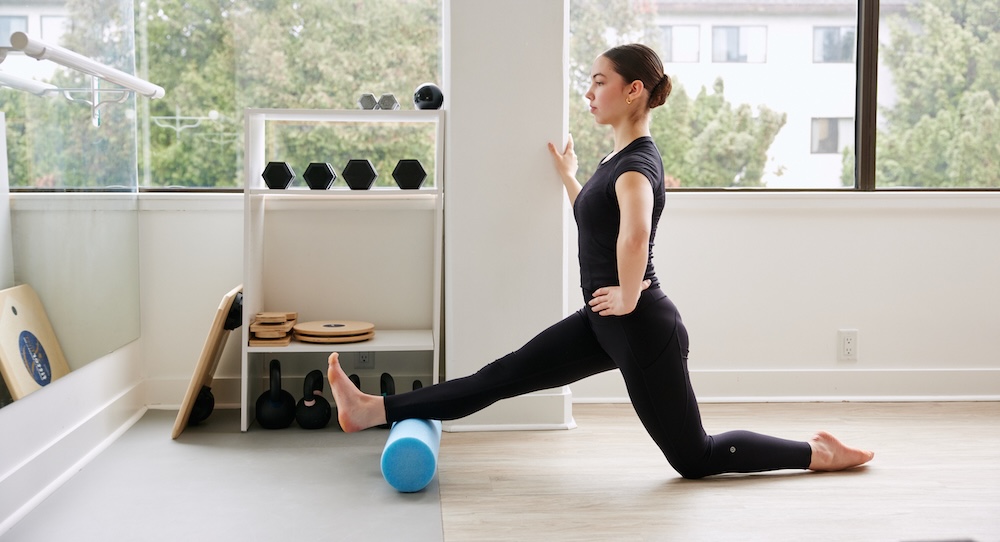
Every dancer wants to be flexible. Supple backbends, soaring extensions, and shapely arches are high on the list of desires. Students may be valiantly stretching day in and day out, with minimal results. Teachers often ask for more feats of flexibility, only to see their dancers become frustrated and burnt out.
Dancers may not need to simply stretch harder. Understanding what is limiting their mobility may be the key to making flexibility training more effective. Recruiting the nervous system is an important component in a successful stretching program or regimen.
In dance, we tend to think of flexibility as a muscle or tissue issue. The nervous system also plays a part in determining how much range of motion a dancer can access. Erika Mayall is a registered physiotherapist and owner/founder of Allegro Performance + Wellness in North Vancouver, BC. She has a keen understanding of how the nervous system affects flexibility and range of motion in dancers.
Mayall says that when properly thinking about mobility, it isn’t just about the muscles. Connective tissues play a part, specifically the joint capsules, ligaments, and other structures that surround the joint. She adds, “It also includes the nervous system. So mobility is a more all-encompassing concept.” She explains that flexibility is one component of mobility. Flexibility can refer to muscle stretchiness or muscle elasticity, but the nervous system and connective tissues also play a big role in how much mobility dancers have available to them.

Mayall notes that there is a relationship between discomfort or pain and the nervous system during stretching. Pushing into discomfort can actually make flexibility less effective. She says, “Pain is a signal from the nervous system. It’s almost like an alarm, or a way for the nervous system to communicate something.” She explains that a dancer can have pain associated with actual damage to tissues, but there can also be pain that is simply the body trying to alert us that something is happening. A lot of pain during stretching can actually be counterproductive because the body thinks that something negative is happening. An injury is a good example of a negative.
She adds, “If we push into, or past that pain, sometimes the nervous system will go into a protection pattern because it thinks damage is happening. There may actually be damage, but even if there isn’t, the nervous system can’t necessarily tell the difference. Pain is an alarm, and the nervous system is going to try to protect us.” In other words, pushing into pain can backfire and cause the muscles or nervous system to protect and limit mobility more.
“One possibility is that the movement is going beyond the physiological limits of the muscle, in which case there may actually be tissue damage,” Mayall notes. “But we can also have the nervous system perceiving something as unsafe when dancers can’t control their mobility well.”
She uses the example of hypermobile dancers who don’t have the strength to control their movements. The extreme positions may be perceived as potentially threatening by the nervous system, which can then begin to protect against them. There can also be stressors that have nothing to do with what the dancer is physically doing at that moment. The nervous system may be in a state of dysregulation if the dancer has had a traumatic or stressful event that day outside of the studio. During such a time, something as seemingly innocuous as the splits or a high leg kick could be perceived as a threat.
Mayall illustrates dysregulation by visualizing a “threat bucket.” She elaborates, “Imagine a bucket filled with things that represent threats to the nervous system. They can be really minor things: an argument with a friend at school or something stressful that happened that day. They can also be bigger things, such as a previous injury that the body is still protecting against or other significant trauma.”
All of these things can fill the bucket. If the bucket is already full and then one more thing is added, such as an aggressive stretching position, that can be the thing that spills the bucket over. The threats don’t necessarily have to be dangerous or life-threatening. They can be an accumulation of all sorts of things happening in a dancer’s life.
Creating a calm and safe environment in the studio can make all the difference. Mayall says, “Having routine structures and consistency can help, especially when working with neurodiverse dancers, but these things can benefit all dancers.” One example teachers can follow is the use of calming breathing techniques to help regulate the nervous system.
“One reason breathing is such a powerful input into the nervous system is that it is both automatic and voluntary. We don’t have to think about breathing (it happens automatically) but we can also consciously control it,” Mayall states. When a dancer is stretching, extending the exhale can help improve mobility because it can have a more regulating effect on the nervous system. Slowing down one’s breathing, particularly extending the exhale so that it is longer than the inhale, can have a regulating or calming effect on the nervous system.
Some dancers stretch consistently but don’t seem to gain flexibility. Mayall mentions that sometimes it can be a sign that the nervous system is limiting things more than the muscle flexibility itself. It could be because the nervous system simply isn’t feeling safe in whatever stretches they’re doing. Traditionally, dancers have done a lot of classic passive stretching: getting into a position and holding it. That is muscle flexibility, but other components need to be addressed. She adds that dancers might need a different approach that looks at mobility as a whole – including the connective tissues and nervous system, in addition to the muscles.
Many dancers seem to reach a point where a stretch just seems to abruptly halt. Mayall says there can be protection coming from the central nervous system — the brain and spinal cord. “Sometimes when dancers reach the limits of their mobility, particularly when they’re not making progress, they may actually be reaching the limit of nerve mobility rather than the limit of muscle flexibility,” she says.
She explains that muscles are elastic, like rubber bands. They stretch and contract. Nerves are different, they are more like a piece of rope. They don’t have the same elastic quality as muscles. They move through the body by sliding or gliding. They’re pliable, but they don’t simply stretch from both ends the way a muscle does. So sometimes when dancers are reaching their mobility limits, it may actually be the nerve that is limiting things more than the muscle.
Mayall cautions against overstretching. Overstretching can make the nervous system feel less safe because dancers are often going into extreme ranges where they aren’t able to control the positions very well. That can create feelings of threat, and the nervous system can go into protective patterns.
She describes how overstretching puts a lot of tension on the nerves themselves. Sometimes dancers will get physical signs of nerve irritation, such as tingling or numbness. If somebody is in a particular position and their feet start going tingly, that can be a sign that the nerves themselves are getting irritated. She quips, “Nerves don’t love tension or compression. They’re very delicate structures.”
Hypermobile dancers have different needs as far as nervous system regulation. Mayall mentions that it is common to see hypermobile dancers who report feeling anxious or tight all the time. That’s often a sign that the nervous system is trying to create tension in the muscle as a way of creating stability if the joints are more hypermobile.
Warming up correctly is an important strategy for stretching success. Mayall recommends that warm-ups have much more active movement than traditional passive stretching. Dancers need dynamic mobility exercises and activation of muscles towards the end of their range. That can include cardiovascular activity, dynamic stretching, and dynamic movements. She adds that strength training can also improve a dancer’s usable range of motion.
Dancers are increasingly being asked for extreme flexibility – higher extensions, deeper penchés, and oversplits. Teachers need to distinguish between anatomical potential and ranges beyond what the body can safely manage. Mayall says the general rule of thumb is that the dancers need to be able to control their body in those positions. “If we’re relying on gravity or other external forces (like a yoga block) to get into a position, that’s unsafe for the body. It can potentially stretch out the ligaments in the joints and damage articular cartilage, with possible long-term consequences.”
For a dancer to safely do some of those extreme flexibility movements, they need to be able to control the position. If they can actively get themselves into a position using their muscles, rather than using momentum, they’re going to be safer than someone relying on external forces.

Mayall adds, “Some of the things we’re seeing are approaching contortion-level flexibility. Often the dancers doing these things may have underlying joint hypermobility or instability. They may be young enough to do it without pain, but if they repeatedly train those extreme positions for years, they may develop longer-term problems.” She recommends caution, even with strong dancers.
Mayall mentions Cirque du Soleil as an example of highly trained contortionists who have spent numerous years developing the muscle control and stability necessary to get into those extreme positions. She adds, “We’re sometimes allowing younger dancers who haven’t had that time to build the necessary control to attempt the same things.” A dancer who can actively control that extreme movement is going to be much safer than one who is relying on gravity or another external force, such as a yoga block or chair.
That is of particular concern with young dancers whose bodies are still growing. Teachers need to understand that they are going through adolescent growth spurts. It is common to see nerve tightness during periods of rapid growth because skeletal growth can outpace the adaption of the muscles and surrounding connective tissues. There can be more tension in the nervous system during those periods..
Mayall would like the dance industry to stop glorifying, or exploiting, young dancers who are naturally very flexible. She talks about how naturally flexible dancers are often praised for their flexibility, and it becomes the thing they seek out and try to push further.
“It’s not always intentional. A teacher may simply see that a dancer can do a particular skill and put it into their solo. But we can be more conscious about how we’re treating those dancers who naturally have that flexibility so we’re not creating problems for them in the future. I would love to see dancers praised more for their work ethic, artistry and technicality.”
Mayall adds that in order to understand mobility, it isn’t just about stretching the muscles. There are multiple components involved, and dancers need to develop the strength and control to use the range they have.
Find out more about Erika Mayall and Allegro Performance + Wellness at www.allegroperformance.com. You can also follow Mayall on Instagram: @dancephysioerika.
By Mary Carpenter of Dance Informa.