
Sydney Fringe Festival, Sydney.
24 September 2026.
There is something inherently admirable about a group of young performers coming together with the ambition to create their own company. Momentum, presented by newly established JT Performing Arts Company as a part of the Sydney Fringe Festival, is born from the vision of founder and artistic director John Tracy. Tracy has assembled a troupe of young performers around a shared passion for dance and performance, and the result is a work that is clearly driven by enthusiasm, commitment and a genuine desire to be on stage.
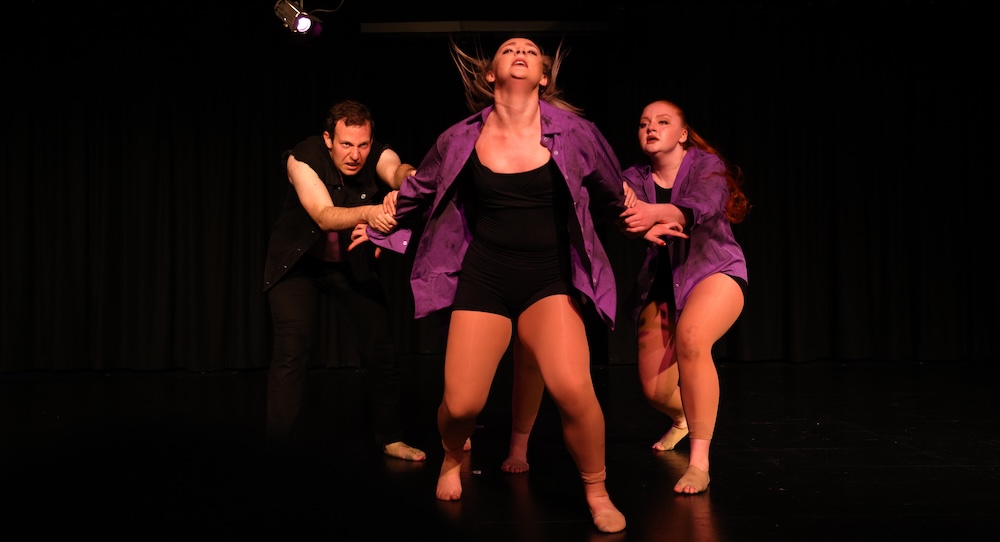
Structured around six concepts – Ignition, Resistance, Fracture, Adaptation, Acceleration and Convergence – Momentum attempts to chart a journey through movement, with four principal performers – Tracy, Piper Sanford, Anastasia Sinclair and Mia Ryan – forming the core of the work. Three soloists, Jasmine Bowtell, Alyssa May and Ashley Miller, punctuate the larger ensemble sections, each appearing between the group numbers.
The intention is clear. What is less developed is the choreographic language required to communicate it.
Rather than allowing the six concepts to generate distinct movement worlds, the choreography frequently remains at the level of dance-class vocabulary: familiar combinations of contemporary, jazz and commercial movement, assembled into sequences that feel more like class choreography than a sustained theatrical work. There are moments of energy and commitment, but relatively little sense of progression or dramatic development. The music often does much of the conceptual work, with the choice of song signalling the emotional territory and rhythmical drive of each section, where the choreography itself does not always provide enough information.
This is particularly noticeable given the ambitious conceptual framework. Momentum promises a progression through ignition, resistance, fracture and adaptation, but these ideas are rarely translated into sufficiently specific physical or theatrical ideas. Movement can be energetic, anguished or expansive, but it does not consistently communicate why it is doing so. The dancers perform the choreography with conviction, yet the audience is left to infer much of the narrative rather than being taken on the journey the work proposes.
The use of predominantly popular music reinforces this impression. While recognisable songs can provide immediate energy and emotional accessibility, here they sometimes make the work feel closer to a dance showcase than a choreographically conceived production. The music establishes atmosphere; the movement does not always extend or compliment it.
The dancers work hard and perform with evident commitment. At times, emotional intensity is expressed through large gestures and exaggerated facial and physical expression rather than through the more nuanced performance skills that allow an audience to understand what is happening without being explicitly shown.
Principal dancer Mia Ryan stood out with a strong technical foundation, clarity and control in her movement, and noticeable stage presence. The soloists offer opportunities for individual expression, but the contrast between the solo and ensemble sections does not ultimately create the structural or dramatic progression the work needs. Instead, the recurring pattern of group number, solo, group number, solo can begin to feel presentational rather than dramaturgically motivated.
Visually, the production is similarly straightforward. The principal dancers appear largely in black shorts and leotards, with variations in tops, while the soloists adopt individual streetwear-inspired looks or leotards and tights with sheer layers. There is nothing inherently wrong with simplicity in costume, but here it contributes to the overall sense of a developing dance showcase rather than a fully realised professional production. A stronger visual language might have helped distinguish the six stages of Momentum and reinforce the conceptual architecture of the work.
And yet, it would be unfair to overlook what is positive about Momentum. These performers clearly want to dance. They are committed to their work, they throw themselves into the choreography, and there is an infectious sense that they are enjoying the opportunity to perform. That enthusiasm matters. The Sydney Fringe Festival provides a valuable space precisely because it allows emerging artists and companies to test ideas, take risks and find an audience. There is something commendable in Tracy’s determination to create an environment in which emerging performers can work, perform and develop.
While Momentum feels like the beginning of a journey rather than its destination – an energetic first step from a young company — the challenge now is to build on that enthusiasm with the discipline, mentorship and choreographic development required to turn enthusiasm into artistry. With the right guidance and continued commitment to their craft, JT Performing Arts Company has the opportunity to grow that enthusiasm into something genuinely compelling.
By Linda Badger of Dance Informa.