
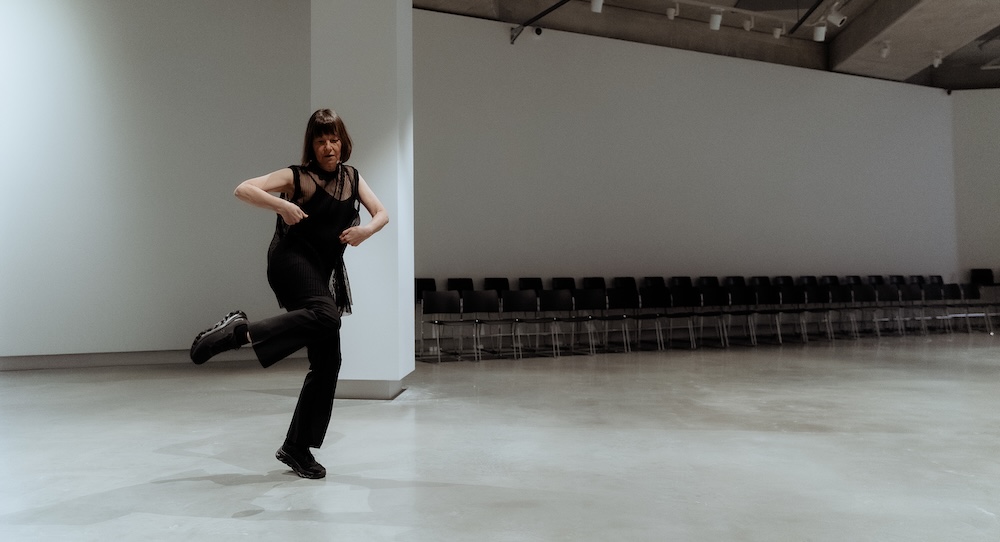
Buxton Contemporary, Melbourne.
15 October 2026.
From the wide horizons of the Eyre Peninsula (via Adelaide, New York and Melbourne), to a stark cubicle in an art gallery, a dancer’s body moves through a lifetime of shapes and places. Now, north of 60, it carries the various choreographies, encoded like DNA, like memory, in its sinews. In a magic-realist way, this body exists in both its present and its past. Like the work it is embodying, it is at once a story and a refutation of narrative.
With her place in the modern pantheon of Australian contemporary dance secured, Lucy Guerin returns to the stage for the first time since 2013, for what she herself refers to as a “final” solo. Now, mere weeks from leaving the company she founded 25 years ago, she is clearly reflective. Consequently, Place Dances is as much a physical memoir, an unpacking of personal processes, as a refined and minimalist artwork. Indeed, as she intimates, the inherent contradictions are very much part of the architecture. The ‘place’ is both specific – this room, now – and anywhere.
Place Dances is also a solution to a problem. How to distil a six-decade journey into 45 minutes. How to work within the constraints of an older body. As Guerin told Dance Informa when she spoke with us in June, “I can’t do now what I could do even at 50, so it’s a very different body I’m working with.” Thus, the choreography is restrained, landing closer to gestural than athletic. Even so, the discipline and detail remains, etched in little flicks and half turns. Combined with both live and recorded voice, her moves have the feel of sketches, perhaps even of echoes.
Also of note, the room, with its two central columns, both of which act to occasionally obstruct sightlines. Surely, this is neither accident nor inconvenience. As metaphor, the unseen is powerful. The performance, the star name, the accolades, are not everything. Guerin knows this. Dance contains much that is invisible.
And yet, stripped of such overlays, it is motion, pure and simple. The human body, as it has evolved to do, stretching and moving in time and space. Reflexive, instinctive, deliberative. A pas de deux with the world.
Then…backing into an elevator, the black clad figure of Lucy Guerin is gone. The place is left behind; the dance is somewhere else.
In an artform that, like sport, privileges youthful virtuosity, the 60-something dancer is a rarity. However, rather than asking us to applaud her for getting older, Guerin leverages the limitations of aging, working them into a framework informed by vast experience. This is not the old pretending to be young or begging for our indulgence, but a lifelong dancer employing all she has both gathered and lost to muse upon what it might mean (or not mean) to dance.
At the end, despite the Brutalist room, I could not help but envisage another place. A rural scene. Cereal crops and savoury scented dust. Blue skies and clouds of flies. Bird calls, seeming to travel for miles. The Southern Ocean, violent and endless. And a girl, dancing in the back paddock, choreographing a kind of eternity.
Here, there, every place.
By Paul Ransom of Dance Informa.