
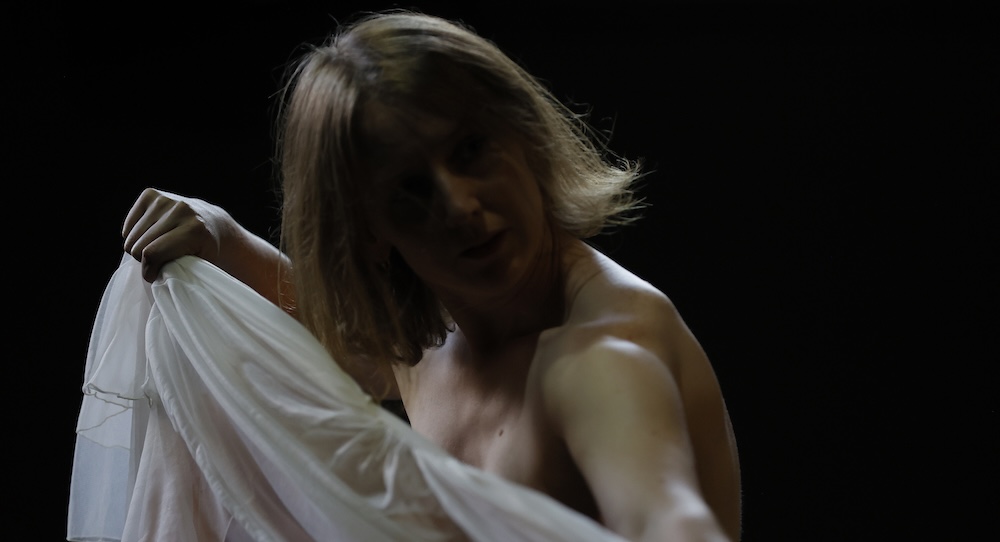
Chunky Move Studios, Melbourne.
3 October 2026.
She walks into frame. She looks fragile, disoriented. Around her, a brute, high-walled space. She is soft and small in this cavern of hard surfaces. It seems to diminish her. Is she a patient, a prisoner, a lab rat?
Thus begins Immacolata, Caroline Meaden’s Melbourne Fringe solo, a work that seems coiled with twin aches, to shrivel and to flower, retract and explode. Indeed, everything about it screams tension, as though it were a struggle against bonds or, worse, self. Yet, somehow, this dystopia has flex, allowing concession. Pictures on the wall, clothes, a seat. These are noteworthy details. Cracks in an otherwise steely edifice.
Or should I say, something warm and alive in an attentionless void? A little wriggle in the perfect geometry of eternity? Meaden’s body is the fluctuating, yet familiar touchstone in an abstract realm, as though she were the glitch in her own work, the messy interloper in a highly conceptual, stripped back hour of contemporary dance.
There is, too, a sense of narrative, a path through. Although the choreography is broken – paused, interrupted – Meaden returns to phrases, cycling back and adding emphasis, sometimes even giving up.
But then we remember the immaculate, the something birthed from nothing. Are we hoping for such a miracle here, a magical deliverance, or are we instead shedding, stripping away the clutter of story and meaning? Is Caroline Meaden – dancer, choreographer, Green Room nominee – trying to strip away the standard issue scaffolding associated with the artist and their work? Maybe, she hints, all we need to know is that there is a woman dancing alone on a sparsely decorated stage.
This paring motif is everywhere. The show is mostly illuminated by single source lighting, and the tricks of production are kept to a minimum. The set is largely undressed, and Meaden herself peels layers.
The counterpoint, an injection of disobedient busyness, arrives with the sound of birds. Hinted at early on, towards its end Immacolata becomes a wash of avian squawk. Metaphors of flight, of escape, are hard to avoid. So, too, the raucous physicality of the flock, which suggests both ordered society and hard-wired wildness.
If, at times, Immacolata feels like a remote, private reality, it may well be that this is our porthole. It is audiences that want viable theories, who muse about ‘about.’ What looks so much like Meaden’s arc could be her journey to free herself from journeys. To make a world ex nihilo, as though the whole thing had been immaculately conceived.
That said – and setting aside further critic waffle – this work burns and bleeds with anguish. The orchestrated dryness of the staging does little to conceal it. We all hide behind our ideas, our taglines; and to seek this form of shelter is avowedly human. Meaning: raw and porous and easily breakable. Not immaculate at all. That may say more about me than you care to know, but this impression, above all else, reaches out.
The lone performer on stage is so often said to be exposed, yet is it perhaps the show which is the safe space.
By Paul Ransom of Dance Informa.