
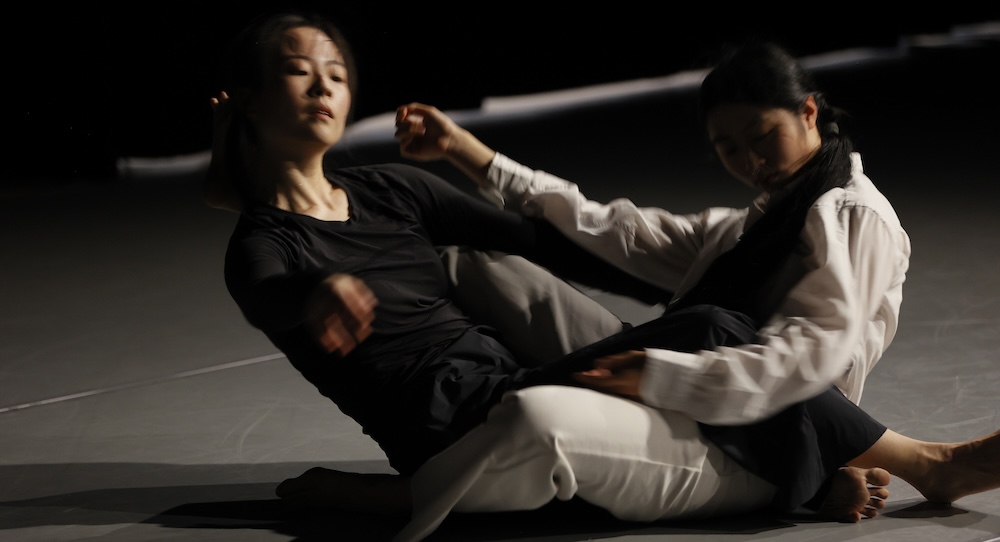
Dancehouse, Melbourne.
2 October 2026.
The universality of dance as the music of the moving body makes it an ideal vehicle for synthesis. In Green, In White encapsulates this, literally and figuratively.
Although rooted in the age old Chinese white snake fable (with its timeless motifs of love and betrayal), its flowers bloom in many forms. Here, the snake feels more like a river, a collector of raindrops winding towards a sea that promises more than the sum of its diluted parts. Perhaps this ocean is a wellspring of transformation — a new water cycle, a new skin for an old snake.
In choreographic terms, this translates as a beguiling, mesmerising melange. Dancers Cui Weichen and Feng Jaiwen shapeshift between ancient and modern, veiled and revealed. We see the sinuous forms and articulated gestural precision of both East and South Asian traditions spliced with hints of panto and mime, drag and waack. Similarly, we slip between a classical, refined aesthetic and an oversized TikTok-style dopamine hit. There are moments of nigh calligraphic elegance juxtaposed with sequences of kitsch excess.
This is reflected in the work’s artful staging. The costumes are elaborate, recalling a perhaps misplaced nostalgia for courtesans. The lighting straddles the brutal and the subtle, the music is both cinematic and textural, and the two portable phone-shaped screens (upon which the dancers’ shadows move with curvaceous mystery), act as hinges, swiping us from Chinese folklore to screen print simplicity to pop video. At every turn, In Green, In White slithers across borders, weaving its way through time, memory, and fantasy.
Is it an evocation or an act of resistance? Cui Weichen’s deft, elastic choreography teases both possibilities. Case in point: a sequence roughly halfway through that lurches towards farce, as though the rigour of Chinese classicism were being consciously upstaged by a pastiche of cliché: geisha girls, competing concubines, etcetera. It as though Cui has adopted a colonial, fetishised view, pushing the notion of the exotic/erotic back at us. In truth, it breaks the trance, and is the thorn at the heart of the work.
In Green, In White is unquestionably beautiful, whilst at the same time questioning our ideas of beauty. Obscured by the exacting technique of classical dance and its body perfect ideals, hidden in the long grass of our often unacknowledged bias, awaits the snake.
However, amidst the slippage, one thing is certain. This is a finely honed, minutely detailed work executed with both discipline and passion. Its gathering of forms into a fluid whole is more than merely clever or daring. At times it is stunning, like a technicoloured historical epic. Perhaps, in this, I am falling into a trap – duped once more by beauty into mistaking poison for nectar – but even this folly may be registered as a note in the serpentine, polyglot music of dance.
By Paul Ransom of Dance Informa.