
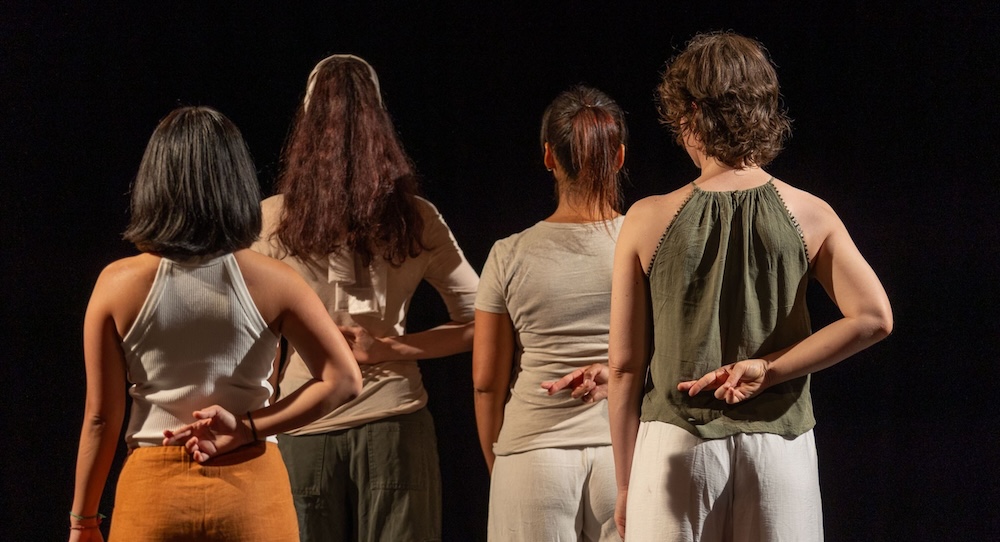
Norla Dome, Mission To Seafarers, Melbourne.
7 October 2026.
Sometimes, it is beautiful to be wrong.
Of all artforms, dance invites such divergence, enticing us to guess, to read into movement alternative intentions and meanings, as though it were a body language designed to be misread. Contemporary dance, with its less narrative tendencies, can exacerbate this.
Of Elena Osalde’s 100BPM, I can confess to an experience almost directly at odds with the sentiments expressed in the official Melbourne Fringe blurb. If the creator’s desire was to portray unity in diversity, I was moved by something more atomic, more metaphysical. That two such apparently oppositional readings can spring from the one work is a big plus.
100BPM begins, as you might imagine, with just that; a simple, quantised thud, an elevated heart rate. Four dancers traverse an intimate, circular space, passing one another like city pedestrians, seemingly oblivious. Perfect modern citizens, individuals in bubbles, visible yet remote. For a while, like the monotony of traffic, it seems like this is all there is.
But then the gestures begin. We witness fragments excised from the social, the devotional, and the choreographic. Each one a jigsaw piece, scattered with no sense of picture. Thereafter, the beat is overlayed with melody, and the digitised elements soon resemble a code. Which is when it hits. There is no whole, only parts. Storylines, meanings, and overarching visions come later. As we invent them.
I am moved by what I take to be an existential clarity. Dream what you may, for this is merely a sequence of events, of movements repeated, of variations introduced and discarded. Time, blind to itself, unfolding in sublime procession. The universe counting to a hundred. Nothing more to see. How liberating.
The way in which Osalde and her team segment their work has the effect of revealing its constituent parts in high contrast. Even as the quartet mould together, their connection seems programmatic. Indeed, their ‘group hug’ resembles a statue more than a genuine coming together.
Later, having dived into the blurb in greater detail, I realised the artist’s motivation was not so cosmic. 100BPM is less focused on the parts, more on the whole. With a consciously diverse cast – different backgrounds, body types, dance smarts – the work physically manifests the way plurality often strengthens singularity. Hence the gestures, which run the gamut from selfie poses to balletic forms. And all this within the cosy, cave-like embrace of the Norla Dome. How could I possibly have missed it?
To be honest, I am glad I did. My interpretation still makes so much sense, if only because I feel the work has reminded me how easy it is to be mistaken. After all, these were mere phrases sequenced on a grid of beats. My dot-joining was yet another example of the pervasive fiction of ‘about’.
The team behind 100BPM should, however, be in no doubt that this is intended as high praise. Art is all the more beautiful when it allows us to behold it with such idiosyncratic eyes.
By Paul Ransom of Dance Informa.