
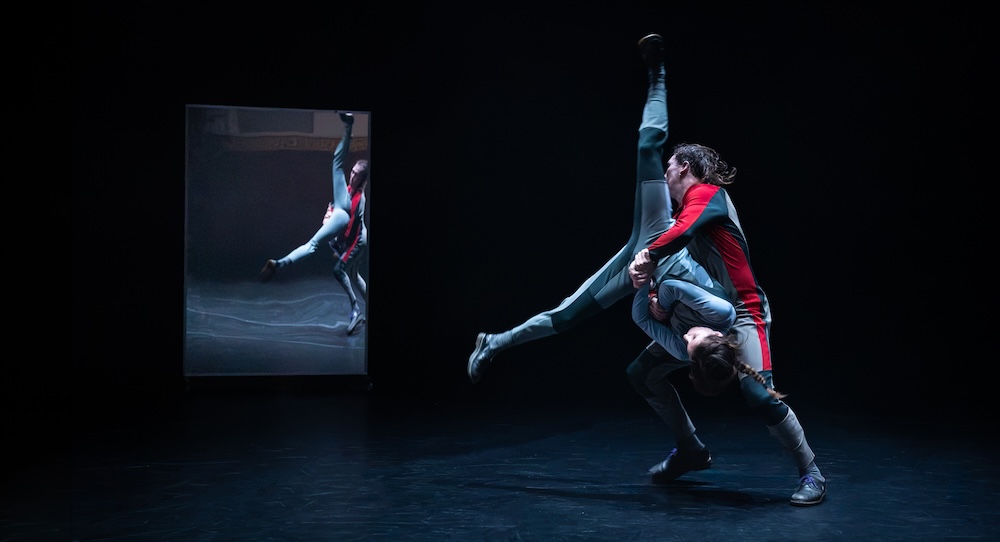
Arts House, Melbourne.
16 September 2026.
There are moments when R.A.I.N looks more like rehearsal than performance. The surface seems shot with holes, through which we are invited to peer. There, we catch the dancers (Harrison Ritchie-Jones and Michaela Tancheff), mid process. Still polishing, still questioning, still breaking open an idea. It is as though the work is unfinished and might soon become something else. Or disintegrate.
To begin, a spot comes up on an empty floor. In silence. Is this the obvious blank page metaphor or a muddling of sequence. Are we looking at the before or the after? An angled mirror upstage-right hints at the possibility of both.
When Tancheff and Ritchie-Jones emerge, we watch them construct, but their movement appears slow, as though each were tentative, feeling out the choreography before committing to it. They toy with motifs from social and folk dance, with hints of Jane Austen ballrooms, Latin fiestas and Riverdance kitsch. Into this mix, they throw the recognisable shapes of ballet and contemporary. The black box has become a building site.
However, the clunkiness is deliberate, the imprecision precisely orchestrated. As the work progresses, the physical intensity lifts and the dance pings between unity and fracture, repetition and invention. A narrative, a relationship, coalesces, only to splinter.
Much like the on-stage duo’s previous collab, (2024’s Cuddle), R.A.I.N plays with assumptions surrounding contemporary dance, pushing into the comic and clumsy, whilst toying with character and panto silliness.
Yet, on closer inspection, this is a well-oiled machine. The work-in-progress vibe does not obscure the choreographic and muscular virtuosity. Granted, there is nothing genuinely form-breaking here, but the constituent parts we recognise are artfully jumbled. The result is a piece that teases. Not unsettling, but enough to make you blink…and wonder.
Threaded throughout, lines of text and bursts of music; all of which underscore the modular structure. We swing from opera to trip-hop, from heavily processed to naturalistic voices.
Likewise, we switch from stark to diffuse lighting, ominous mood to chilled interlude. R.A.I.N appears to continually reinvent itself, to be an anthology of remembered phrases and conflicting impulses.
Yet, for all that, the performance is energetic. Moreover, the chemistry between Ritchie-Jones and Tancheff is palpable. Their bodies move with synergistic comfort. In truth, it is the trust and intimacy of this partnership that glues the work. It is also our connect point. Relationship, and its broken arcs.
Finally, as they gather centre stage, talking quietly – debriefing, reconciling, breaking up? – we understand it could easily be us sitting in their place. Tabula rasa, memory full, or anywhere in between.
By Paul Ransom of Dance Informa.