
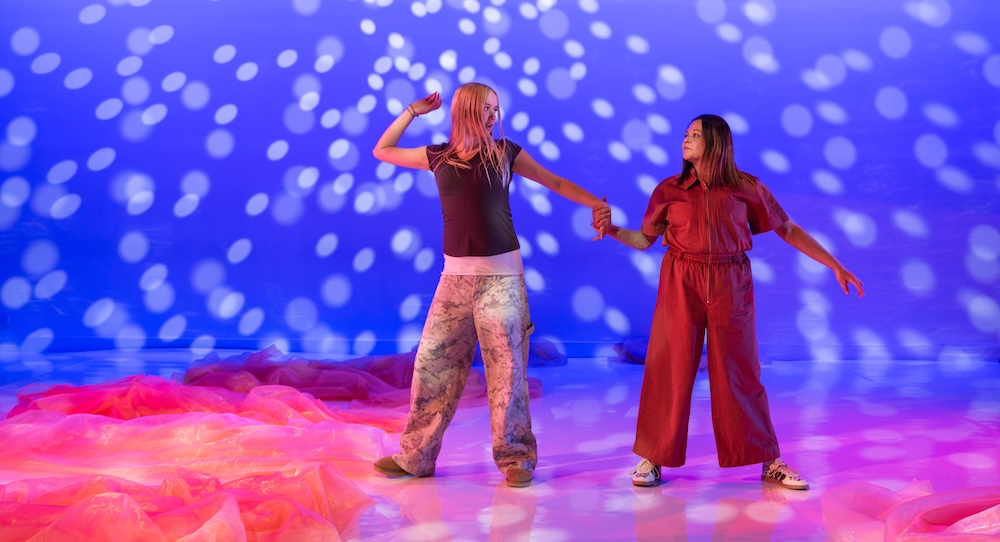
Campbelltown Arts Centre, Sydney.
17 September 2026.
There is something disarming about watching a mother and teenage daughter sit at opposite ends of a stage and have what appears to be an entirely ordinary conversation. In My First and Last Solo Show, Natalie Rose and her 15-year-old daughter Mabelle begin with the mundane rhythms of their relationship: teenagers, mothers, cars, embarrassing clothes, and the eternal questions of whether your mother really understands you. It is funny, recognisable and deceptively light.
Then the layers begin to fall away.
Rose’s first solo work was never destined to remain a solo. Originally conceived as a gift for Mabelle, the work evolved into a collaboration between mother and daughter, co-devised and performed by the pair. The result is a work that sits somewhere between theatre, autobiography and movement, although theatre is undoubtedly its dominant language. Movement is threaded through the storytelling rather than driving it, with Emma Saunders credited as movement director.
For Rose, this is deeply personal territory. A Western Sydney artist and theatre-maker, she has worked across Australia’s contemporary performance sector for more than two decades, with work presented by organisations including Sydney Festival, Belvoir, Sydney Theatre Company and Sydney Opera House. Here, however, the scale is intimate. Rose stands largely as herself, telling her own story and inviting her daughter to tell it with her.
The stage itself established a sense of distance and concealment. Four pieces of semi-translucent, shimmering rose-coloured fabric hang vertically floor to ceiling, parallel and layered across the space. At one point the performers disappear behind them, creating shifting layers of visibility. The colour suggests rose-coloured glasses: a softened, filtered version of the past. As the work progresses, those filters become increasingly difficult to maintain. Memories are exposed, questioned and re-examined in gradual crescendo over the hour-long performance, and what initially appears to be a playful exploration of motherhood becomes an examination of family dysfunction, domestic violence, memory, and intergenerational trauma.
The opening exchange between Rose and Mabele is deliberately ordinary. Positioned at opposite sides of the stage, they recreate the intimacy of a conversation in a car. They begin playfully, with Rose asking Mabelle whether she would make a good Uber driver, before turning to a question that becomes increasingly significant as the work unfolds: what does Mabelle need from her mother? Is there anything she wishes Rose had told her, taught her or helped her to understand? Mabelle’s responses are quintessentially teenage: she wishes her mother had let her wear particular clothes, dye her eyebrows or make different choices when she was younger. Rose repeats these grievances back to her, turning the small embarrassments of adolescence into a comic conversation about the constantly shifting distance between childhood and adulthood. Rose asks the question lightly, almost as part of the easy banter between mother and daughter, but it soon becomes apparent that it matters deeply to her. She returns to it repeatedly throughout the work, seemingly trying to work out what her daughter needs so that she can provide it. Beneath the humour is a mother attempting to understand how to be the mother she herself did not have.
In retrospect, it becomes clear that Rose is asking a much larger question. She is trying to understand what her own daughter needs from her at 15 and, perhaps more painfully, what she herself needed at that age.
As Rose’s childhood emerges, the memories are not presented as a straightforward chronology but as fragments, some sharply recalled and others seemingly inaccessible. What remains particularly vivid is the sense of being a child growing up in an environment where the ordinary markers of childhood could never be taken for granted. Moments that might otherwise carry the uncomplicated pleasure of friendship, family and celebration are instead shadowed by an awareness that home was neither safe nor secure. It is this contrast that gives the memories their emotional force.
The work’s treatment of memory is particularly effective because it does not attempt to impose a neat chronology on traumatic experience. Rose speaks about having few memories from certain periods of her childhood, while other moments remain extraordinarily vivid. A small television screen evokes the hours she and her brother spent in her bedroom, largely removed from the rest of the house. A telephone with an incredibly long cord becomes a conduit to memories of her mother. Headphones allow performers to shift between perspectives and characters, creating moments of dislocation between first and third person.
The rose-coloured fabric functions in much the same way. It obscures and reveals. Gradually, those layers are removed, as though the work is stripping away the protective filters through which childhood memory can be viewed.
Music provides another form of memory. Songs from the 1980s and ’90s punctuate the work, carrying the sound of Rose’s childhood into the present. Some are simply playful additions to the theatrical world, others feel loaded with the particular emotional force that music can acquire when it becomes attached to a specific time in one’s life.
There is an interesting tension in the movement. Neither Rose nor Mabelle is presented primarily as a dancer, and the choreography does not attempt to disguise this. Instead, their movement can be playful, awkward, silly, and deliberately imperfect. They mirror one another, fall out of sync, return to unison and repeatedly revisit the physical vocabulary of their car conversations. Rather than diminishing the choreography, this gives it an intimacy that highly polished movement might have compromised.
By the end, movement becomes an expression of connection. Mother and daughter dance together, and the simplicity of the duet is surprisingly affecting. Mabelle’s mouthing of the words as they move gives the moment a feeling that is less like a performed duet than something two people have made together and are allowing us to witness.
That distinction is central to the work.
Although it is called My first and Last Solo Show, Rose has discovered that making alone is not necessarily how she works. The work was developed over several years and with a broader creative team, including director Clare Britton, dramaturg Clare Grant, movement director Emma Sauders, sound designer James Peter Brown and a group of peer collaborators. Even the original premise – a solo created as a gift for her daughter – became something shared.
There is considerable bravery in the level of exposure shared. My First and Last Solo Show does not need to manufacture its emotional impact. Its most powerful moments come when Rose simply stands and speaks. The theatrical devices – the fabric, telephone, television, headphones, music and movement – create a structure around those revelations, but ultimately it is the directness of Rose’s voice that stays with the audience.
The work is also a reminder that traumatic histories do not exist neatly in the past. They can surface in the seemingly ordinary moments of parenting, in the questions we ask our children, and in the things we are determined to do differently.
Rose has described the work as being for anyone who has a mum, is a mum, or has ever loved someone deeply. It is an expansive invitation, but an apt one. Beneath its humour, its deliberately imperfect choreography and its affectionate mother-daughter banter is a work about the complicated inheritance of family – what we remember, what we forget, what we carry and what we choose to leave behind.
By the time the final filters have fallen away, My First and Last Solo Show has become something considerably more than a solo.
It is an act of witnessing.
And, perhaps most importantly, an act of breaking the cycle.
By Linda Badger of Dance Informa.