
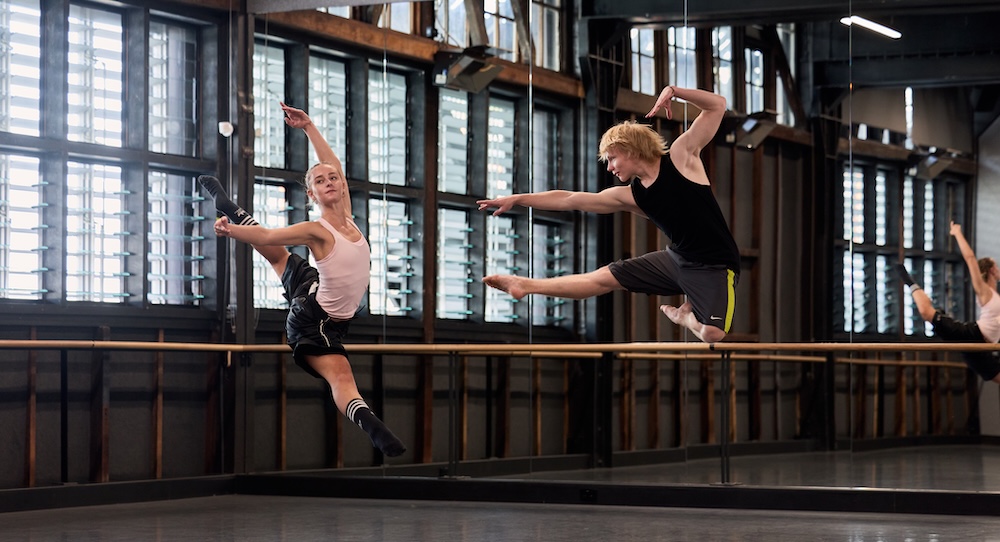
For an aspiring dancer, the question of what comes next can feel deceptively simple: train, audition, join a company. But contemporary dance careers rarely unfold in such a straight line. Today’s artists might move between major companies, independent projects, choreography, interdisciplinary work, touring and entirely unexpected creative opportunities.
At Sydney Dance Company’s Pre-Professional Year (PPY), that uncertainty is not something dancers are trained to eliminate. It is something they are encouraged to explore.
The two-year program places emerging dancers within Sydney Dance Company’s (SDC) professional environment while exposing them to an unusually broad range of choreographers, teachers and working artists. For Head of Training Linda Gamblin, who developed the program, preparing dancers for professional life means looking well beyond securing a first contract.

“We prepare dancers not just for the industry, but for the arts sector as a whole,” she explains. “What a dancer thinks the industry looks like when they begin training may be very different by the time they graduate.”
While technical development remains fundamental, Gamblin describes a broader process involving “technical mastery,” “emotional mastery” and creativity, alongside the confidence and self-efficacy required to sustain a career.
Central to that philosophy is exposure. Each year, PPY students work with approximately 30 to 45 choreographers and practising artists. Rather than training dancers towards one aesthetic or choreographic language, the program deliberately asks them to encounter many. “I almost designed the program I would have wanted for myself in another life,” Gamblin says, “an opportunity to learn from many different choreographers and artists, so you can explore and understand your own creativity.”
Some encounters will resonate immediately; others may be uncomfortable. That, too, is intentional. “We deliberately bring in choreographers whose work might not immediately appeal to every student, because for another student that same experience could completely change their trajectory as an artist.”
The core PPY team directly trains the dancers for only around 30 percent of the time. Just as important is its role in mentoring students through the multitude of ideas and practices they encounter, helping them understand what is being asked of them without prescribing what kind of dancer they should become.
For current student Lia Williamson, that breadth has already shifted her understanding of both dance and success. Williamson remembers arriving at her PPY audition expecting the usual nerves, only to find “the most enjoyable audition I’ve ever done.” Learning a section of Sydney Dance Company repertoire from a company dancer offered an immediate glimpse into the environment she hoped to enter.

Since joining PPY, some of her most significant discoveries have happened far beyond learning choreography. Group improvisation, once intimidating, has become particularly transformative. Dancing for extended periods without set choreography taught Williamson that performance could be compelling through something as small as a gesture, expression or connection between dancers. Her definition of achievement has changed it. “I am now so much more interested in intricacies and the breaking down of movements in my dancing – investigating flows of energy and what I am trying to communicate, rather than constantly pushing for some certain and precise end result.”
It is a transformation that resonates strongly with Sydney Dance Company dancers and PPY graduate Sophie Jones. Jones entered the program from a classical ballet background at a point when she knew she needed a change, but did not yet know where contemporary dance might take her. “My understanding of dance had always been that you could continually improve your turnout, posture, expression or extension,” she recalls. “It was very clear what you are working towards.” PPY disrupted that certainty. Working with a succession of different artists required Jones to become adaptable and, perhaps more importantly, to let go of some deeply ingrained ideas about what dance should look like. She remembers a Sydney Dance Company member telling her to “stop trying to be pretty.” Instead, she began concentrating on sensation, exploring unfamiliar movement practices and becoming comfortable with things she initially found difficult. “Often, the experiences that were valuable were actually the things I wasn’t good at,” she says.
Contact partnering was one example. It demanded trust and ways of using her body that were completely unfamiliar. “I was genuinely really bad at it!” she admits. Yet, those difficult experiences ultimately expanded the classical foundation she already possessed and helped shape the dancer she became.
Jones’ pathway from PPY to Sydney Dance Company was itself anything but predictable. Rather than immediately receiving a traineeship, she was initially offered a one-month contract. That led to an international tour to France, then a national tour and, with her first year, four separate contracts. “Each time I had to step up again,” she says. The adaptability she developed at PPY suddenly had a very practical application: entering professional situations before she necessarily felt ready, trusting herself and finding a way through.

Graduate Tayla Gartner’s trajectory demonstrates another possibility. After PPY, Gartner joined Sydney Dance Company as a trainee for its 2024 season, touring nationally and internationally and performing works by Rafael Bonachela, Antony Hamilton, and Melanie Lane, etc. Since relocating to Naarm / Melbourne, her career has moved increasingly into independent practice, working with artists including Lucy Guerin, Oli Mathiesen and Jenni Large.
For Gartner, some of PPY’s greatest lessons have become clearer with distance. “Learning how to collaborate, adapt and communicate effectively are skills that have been essential moving into different creative spaces.” Patience, organisation and the ability to maintain perspective have proved equally important through “the ebbs and flows of life as an independent artist.” What she perhaps did not fully appreciate while training was the rarity of having two years devoted to practice itself. “PPY is a place dedicated to practice! To learn! To try! To fail! … Having two years dedicated to learning with such quality feedback was a luxury that I feel so lucky to have experienced.”
That freedom to try and fail emerges repeatedly across these dancers’ experiences – and it also sits at the heart of what Gamblin says the panel is looking for at auditions. Technical experience alone is not enough. “We’re looking for exploration, vulnerability and bravery: a willingness to investigate where movement can go,” Gamblin says. She describes technique not simply as mastery of positions, but as “the mastery of movement.” A triple pirouette or high leg may not necessarily capture the panel’s attention; a dancer standing still and shifting in an interesting way might. Authenticity, curiosity and potential matter.
That may be reassuring for dancers wondering whether they are sufficiently “ready” to audition. Williamson questions the idea of readiness altogether. “It can never be wrong to just have a go,” she says. “PPY is here for you while you grow through your life and your practice, and everything you think you know already can be explored deeper. Ideas will change.”

Gartner similarly cautions against believing dancers need to have their careers mapped out before they begin. “I could never have anticipated the experiences that were to come from my time during and after PPY,” she says. “Although it can feel daunting to let go of a fixed image for your future, not having it all figured out leaves so much space and opportunity for things you didn’t expect to spark your interest.”
Some of the most thought-provoking advice, however, comes from Jones, whose journey from ballet student to contemporary dancer required her to repeatedly enter spaces in which success was far from guaranteed. “As dancers, we deal with so much rejection, and I think that needs to be normalised,” she says. An audition captures the dancer at one particular moment; it does not define the artist they might eventually become. Rather than trying to anticipate what an audition panel wants to see, Jones encourages dancers to remain connected to themselves and their dancing. The people watching, she points out, want dancers to succeed. “So give yourself a chance to fail – rejection is part of being a dancer, but it doesn’t mean that is the end of the opportunity. You can grow, you can change, and you can always come back.”
It is advice that encapsulates much of what PPY’s philosophy: arrive curious rather than finished. Be prepared to encounter what you do not know, to discover what does and does not speak to you, and to allow your idea of a dance career to change along the way. As Gamblin tells dancers considering whether to audition: “Trust your intuition – and remember that you are auditioning us as much as we are auditioning you.”
Sydney Dance Company’s Pre-Professional Year applications close 10 August 2026. You can find out more information here: my.sydneydancecompany.com/2427/2429.
By Linda Badger of Dance Informa.