
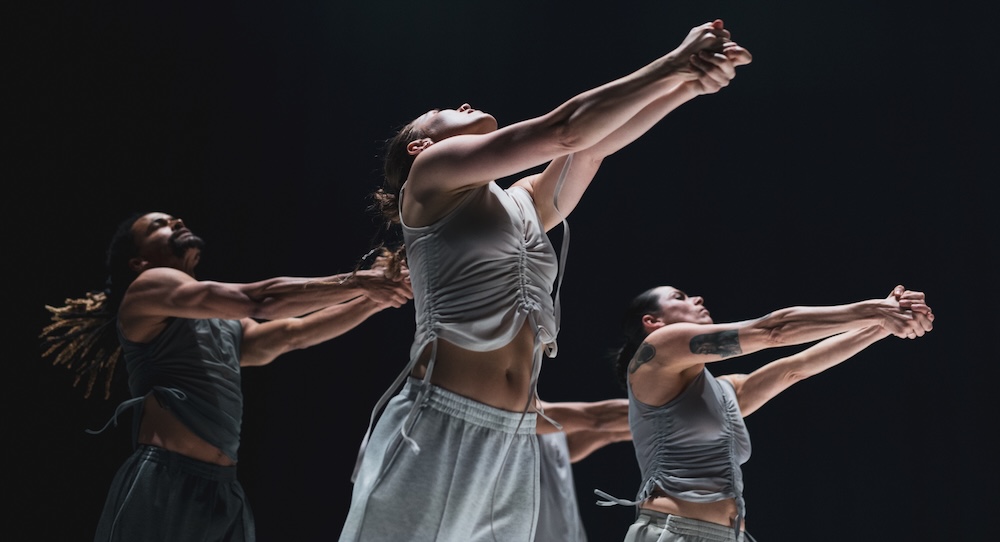
Merlyn Theatre, Melbourne.
24 July 2026.
Reality is one thing; seeing is another. A room of people witnessing the same event will not tell the same story afterwards. Indeed, some would argue that much of what we experience is an echo chamber of self.
For Melbourne based choreographer Stephanie Lake, and her team, the challenge was to both build upon and distil the essence of this idea. Her ingenious response is both blunt and subtle. Show us the same thing twice. But not quite. Cut to another angle. Nudge things out of sync.
Yet, perhaps more powerfully, Vista uses the intermission as a refresh button. Employing distraction to focus our attention, rendering the slippage unmissable. The question is duly raised: is this the same view?
It is a simple, yet potent metaphor, and we see it in choreographic detail, in set and costume designs, and in the breaks and stops embedded in the score. If there’s one thing that unifies the work’s aesthetic it is the use of fractures, or arcs interrupted. Throughout, we get beats of silence, blackness. There are wrenching, slurred tempo shifts. Dancers morph from cooperative to conflictual. The picture, it seems, ever overlaid with static.
Having explored the maximal with works like Colossus and Manifesto, Lake returns to the simplicity of six dancers on a bare stage. However, this is not code for cold or slowed. Vista is propulsive, driven by hyper-articulated, percussive movement and Robin Fox’s glowering, insistent soundtrack. The work explodes into life from beat one, and moves with bristling, contorting energy until we are finally slammed into darkness.
People familiar with dancemakers like Hofesh Shechter – and, to some extent, William Forsythe – will note echoes of both. Vista collides precision with wildness, the architectural with the organic. Ballet lives next to breakdance, the indicative brushes against the figurative. But Lake is able to synthesise all this grammar into a coherent language, as if to counterpoint the inherent subjectivities her work suggests and addresses.
Longtime creative partner Robin Fox has once again enriched her vision. His sonic palette lives on the outer ring of electronica, recalling the glitchy abstractions of Cabaret Voltaire and Autechre, and the brooding, textured rumble of Burial. It is the sound of certainty crumbling to doubt, to a sense nearing menace.
Vista’s six strong ensemble embody all this beautifully. The dance fractionally imperfect, slightly rumpled. Mistake? Deliberate? We question what we are seeing, until even our unease becomes normal. Becomes part of the work.
During interval, someone told me the dancers reminded her of “strange little creatures, moved by body, not intellect.” It was an astute observation. Often, the dancers seem like bodies acted upon, children spun to face a certain way. Yet, they are never entirely in unison. To each, the god of dance whispers a slightly different secret. The vista, it would seem, is composed of many sights; never to be seen twice.
Lake’s vision, meanwhile, is sharply honed. Her blend of fast tempo, big ideas, and athletic choreography ensures a quick ride. Vista does not dwell. It is restive, reactive, and we are pulled along. Before being let off the leash. Twenty minutes to forget, to anticipate the next, before doing it all again. Yet not.
Now, what do you see?
By Paul Ransom of Dance Informa.