
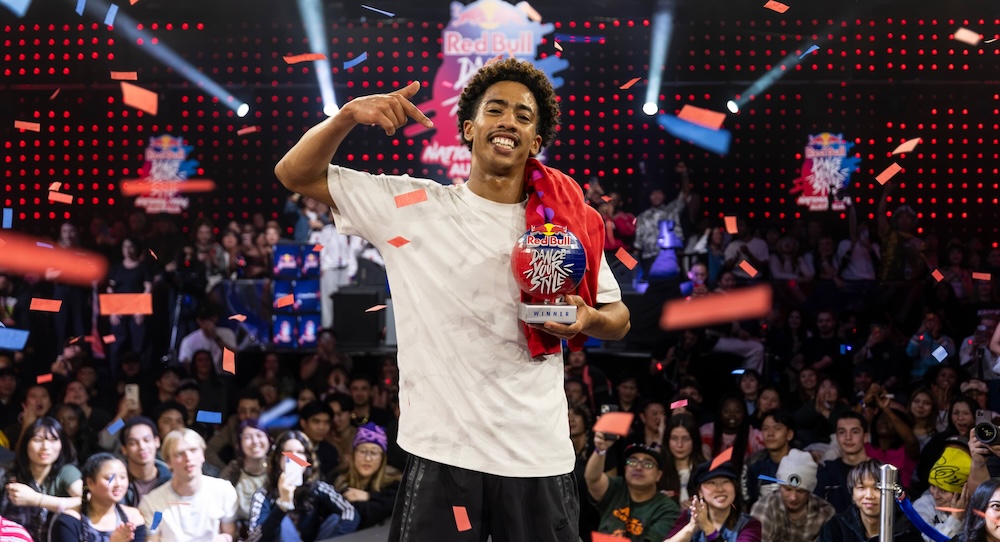
Hordern Pavilion, Sydney.
25 July 2026.
A sold-out Hordern Pavilion became an arena of movement, music and personality for the 2026 Red Bull Dance Your Style National Final, as 16 street dancers battled for the chance to represent Australia at the World Final in Zurich this October.
Ultimately, it was 19-year-old Rome who took the title, defeating reigning champion Nonoy in a final that demonstrated exactly what makes this competition compelling: technicality matters, but so too do musicality, spontaneity, personality and the ability to bring an audience with you.
The field brought together 12 invited dancers – Nonoy, Caro, Lerato, Jiggy Jaya, Haz Money, Jasha, Thu Flood, Hanon, Deco, Angelina B, Amanda Va and Aki – alongside Wildcard qualifiers 4man, Hu Jeffery, Waackyoume and Rome. It was a diverse final 16, not only in personality and approach but in the street dance forms informing each dancer’s individual style.
Dance Your Style operates differently from a conventional dance competition. There is no judging panel and dancers do not know what music they will face. Instead, they improvise one-on-one to tracks selected by the DJ, with the audience deciding the winner by raising either a red or blue light.
It makes for an unpredictable night, particularly when the soundtrack moves freely across decades and genres. DJ Kez drew heavily on tracks familiar to anyone raised on the music of the 1990s through to the 2010s, alongside newer releases. He recognition was often instantaneous, creating a shared nostalgia between dancers and audience and giving competitors another layer to play with.
The format also revealed just how broad the definition of street dance has become. There was relatively little breaking compared with the battles of previous generations. Instead, hip hop, popping, locking, waacking, house and hybrid movement languages dominated. Most interesting was how clearly individual identities emerged. Each dancer approached the music differently; some vocabularies were more developed than others, but collectively the 16 demonstrated the remarkable range that now sits beneath the street-dance umbrella.
Among the women, Amanda was particularly impressive. Her movement has the assurance of someone who has spent considerable time honing an individual language: detailed, distinctive and deeply musical. Her elimination against eventual champion Rome in the top eight was one of those quirks inherent in a knockout competition. Against another opponent, she could easily have progressed further.
Their battle was also one of the night’s strongest examples of competitors genuinely responding to each other. Rather than simply take turns, Amanda and Rome created a playful exchange, acknowledging and extending each other’s ideas without allowing the interaction to overwhelm their own dancing. It was battle as conversation rather than confrontation.
Hanon was another standout, displaying speed, precision and an impressively broad movement vocabulary. Comfortable moving between fluidity and the sharper, disjointed articulations associated with popping and locking, she possesses something particularly valuable in freestyle: a clear understanding of who she is as a performer.
Then there was Thu flood, whose long-limbed, idiosyncratic movement made him one of the evening’s most intriguing characters. Entering and leaving the space decisively, he created strange little worlds through animalistic gestures and theatrical imagery. A recurring bird motif, at one point flying before being dramatically shot down, demonstrated an imagination extending beyond simply responding to rhythm. He may not have looked like the eventual champion, but he certainly left an impression.
Waackyoume also made an impact in the later stages of the competition, particularly in facing Nonoy. While her movement vocabulary did not always have his technical fireworks, she found other ways to claim the space, working the room with determination and creativity. At one point, she began from within the audience before making her way onto the stage, while props including scarves and towels became extensions of her performance. Against a formidable reigning champion, she committed fully to making the battle her own.
Nonoy remained one of the most technically exciting dancers in the field. His sharpness and control were undeniable, and a momentary headstand was among the night’s genuine displays of physical virtuosity. Yet, his performances could also feel strangely restrained. He frequently appeared to finish before his allotted time and, despite possessing some of the evening’s biggest tricks, rarely built them into the sustained crescendo his considerable skill suggested was possible.
His battle persona also leaned heavily into mocking his opponents – certainly part of battle culture, but increasingly repetitive alongside dancers who found more inventive ways of engaging with their competitors.
That difference became particularly apparent against Rome.
Where Nonoy could appear assured enough to hold something in reserve, Rome seemed determined to discover something new every time he entered the floor. Smooth one moment he combined strength, groove and flashes of breaking with an easy charisma that made his performances feel open rather than calculated.
His pathway to victory was not straightforward. He faced Amanda in the top eight before eventually meeting the defending champion in the final. Across four battles, however, he continually found another gear, culminating in a final danced to DMX’s “Party Up (up in Here)” and Yeah Yeah Yeahs’ “Heads Will Roll.” Rather than relying on one spectacular trick, Rome built his victory through variety, musical responsiveness and an evident pleasure in performing.
Most importantly, in a competition decided entirely by spectators, he understood his audience. His delight when the Pavilion finally turned its lights in his favour was equally infectious.
The competition itself was only part of the evening. Hosts Xander Xander, Unice Wani, Dom Di Tommaso and Kez kept proceedings moving while guest dance crews, DJs and performers filled the spaces between rounds. Showcase performances, crowd cameras, music and entertainment extending outside the Pavilion created something closer to a street-culture festival than a conventional dance competition.
And that atmosphere matters. Audience voting inevitably means Red Bull’s Dance Your Style cannot definitively identify Australia’s “best” street dancer. Pairings influence who progresses, popularity and charisma matter, and another draw could produce a very different final four. Strong dancers can meet stronger opponents early, while others can find a more favourable route through the draw.
But perhaps that unpredictability is also the point.
Dance Your Style rewards the performer who can meet an unknown piece of music, an opponent and several thousand people in the same instant – and make something happen. One this night, that dancer was Rome.
By Linda Badger of Dance Informa.