
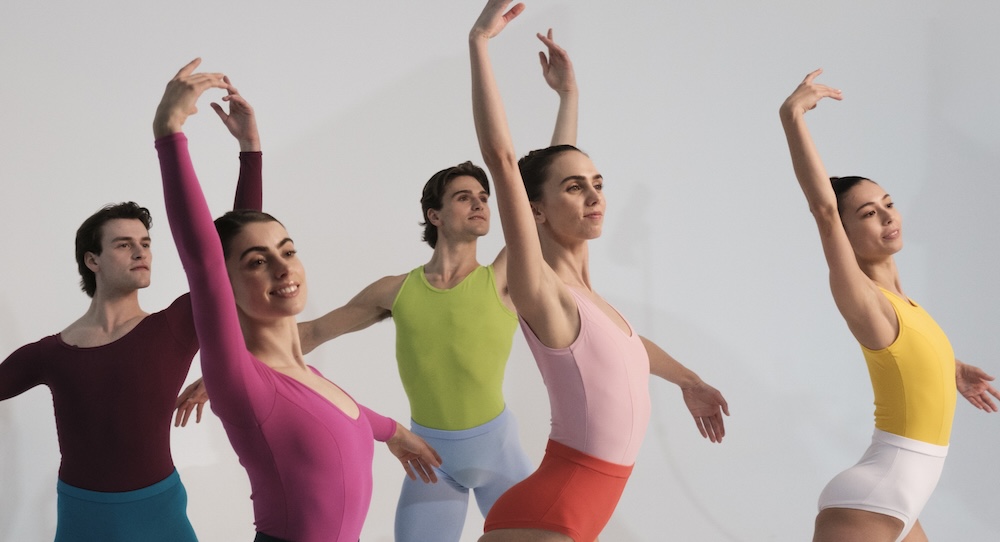
Ballet is often regarded as a distinctly European artform. However, as it spread globally throughout the 20th century, it took root in the so-called ‘new’ world. Now, in 2026, we do not even blink when The Australian Ballet performs work from young American choreographers. Neither are we fazed to discover that it will be danced to a quintessentially modern American score.
When the nation’s top tier ballet company launches the Australian premiere season of Justin Peck’s Copland Dance Episodes in late June, it will almost certainly speak to an expat reimagining of old country forms. Not in any forced way, but rather as a corollary of the dance cultures of both the antipodes and the Americas.

Soloist at The Australian Ballet, Larissa Kiyoto-Ward, is clearly a fan of the departure. Her enthusiasm for the piece, and for Peck’s work more broadly, is immediately apparent. “It’s definitely really musical,” she declares, of both the work and the American take on ballet. “All the steps have a note, or it really fits in with the music. It’s also more ‘dancey’, in that there’s more individuality. There’s not so much, like, swans or anything, where you have to be the same. Everyone can kind of have their own individual style.”
In a work that features 30 dancers negotiating a quickfire playlist of 22 pieces from the now-revered back catalogue of composer Aaron Copland, allowing for individual nuance might seem like a recipe for mess. Kiyoto-Ward is here to suggest otherwise. Although the repetiteurs have not insisted on exact replication, she clarifies, “They will tell you if it looks, like, strange or anything.”
Beyond the specifics of Peck, Copland, etcetera, the core question is about the relationship of the dancer to the choreography; the speaker to the language. The tension between individual expression and the demands of synchrony and repeatability are not new. While pundits and others mull over the theory, in the rehearsal space the friction becomes a creative energy.
As Kiyoto-Ward duly notes, “People who’ve done training at the School of American Ballet might interpret it differently compared to those who’ve never done any American style dancing. It’s actually really cool to watch.”

Indeed, at the company level, she sees the advantage. “We’re pretty diverse here because there’s a whole bunch of people that have different dance backgrounds, but I think, especially with the repertoire that [AD, David Hallberg] has brought in over the last few years, everyone’s adapted to different styles really well. There’s no particular style that we do, so it’s actually really nice to see everyone do the Peck stuff, because everyone interprets it their own way.”
On that front, she has special insight. Her first onstage solo with The Australian Ballet came in 2023, in Peck’s Everywhere We Go. Three years later, she will again tackle a Peck solo. “With his stuff,” she reveals, “there’s a moment where you realise that you just have to keep doing it to understand what the movement is. It can take a few goes. Like, ‘okay, what feels good here, do I have to do this a certain way?’ But, the more you do it, the more ‘in your body’ you feel.”
If both Australians and Americans are noted for bringing greater muscularity and athleticism to ballet, Peck’s Copland Dance Episodes drives it further. Harder. Asked whether the work requires anything different from her, Kiyoto-Ward concurs. “For sure. It’s definitely more physical. It’s also very dense in the choreography. So, if there are 16 counts, all 16 are dancing. There’s definitely no standing. It’s quite tiring because it’s very different movement as well. You use all your physicality when you do Peck’s pieces. So, you get tired quicker, but it’s also more fulfilling because you’re reaching a little further than what you’re used to in your technique.”
Running through it all, Copland’s compositional language. The man dubbed ‘the Dean of American music’ is best known for the anthemic Fanfare for the Common Man. He is variously considered populist and highbrow.

From the dancer perspective, however, music scans differently. “It’s so cool,” Kiyoto-Ward waxes. “I mean, I don’t think many people would be able to choreograph to Copland, but yeah, it’s awesome. It’s like that saying, ‘see the music, hear the dance.’ That’s very much what this piece is.”
When Copland Dance Episodes opens for the first time outside New York, both Melbourne and Sydney audiences will have the chance, once again, to test the frontiers of the artform. Labels and expectations aside, it will, Kiyoto-Ward argues, retain traces of the individuals who made it. “There’s no particular story to it, but it seems like there is. It’s also really cool to see everyone’s differences as we go through it.”
The Australian Ballet will present Justin Peck’s Copland Dance Episodes in Melbourne (23 June – 2 July) and in Sydney (6 – 21 November). For tickets and more information, head to australianballet.com.au/performances/copland-dance-episodes.
By Paul Ransom of Dance Informa.