
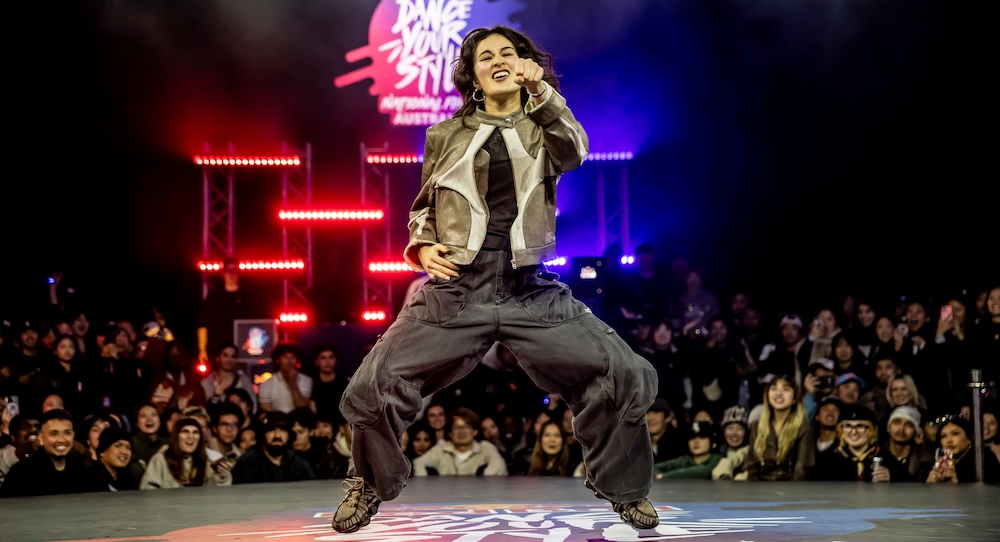
Amanda Va’s viral battle at Red Bull Dance Your Style 2025 introduced millions to her effortless musicality and freestyle prowess. Ahead of this year’s National Final, we spoke with the Canberra-raised dancer about her unexpected rise to online fame, the realities of freestyle competition, and the community that shaped her journey.
Your battle to 50 Cent last year exploded online. Did you expect that moment to resonate the way it did?
“Not at all. The moment in real life felt quite electric, and I remember going home thinking, ‘Wow, that felt amazing. What a great night.’ Then, the next thing I knew, it had blown up online, happening really quickly. Overnight, I went from around 2,000 followers to 5,000, then 10,000. A couple of days later, it was around 50,000. I definitely didn’t expect any of it, but it was a really cool experience.”
What do you hope people might understand about the amount of work behind a viral moment?

“A viral moment is actually something that’s quite fleeting. To be honest, I look around at so many of the dancers in Australia and think, we’re incredibly talented here. I wish everyone could have a viral moment because everyone works so hard. People are constantly training, supporting each other and putting in the work behind the scenes. What audiences don’t always see are the wins and losses, the challenges, the setbacks, and even the burnout. They see one moment online, but there’s so much more behind it. Sometimes these things happen almost randomly, and while I’m grateful for the attention, there are countless talented people doing amazing work every day who are equally deserving of recognition.”
Canberra isn’t always the first city people associate with street dance. What was your dance journey like growing up there?
“I started in hip hop choreography and competition teams. Canberra’s dance community is actually very small, but it is incredibly strong. Everyone supports each other because the scene is so close-knit. At the same time, everybody pushes each other to improve. I wanted to keep developing, so I was travelling to Sydney almost every week to enter battles and take classes, to upskill and bring that knowledge back to Canberra. Eventually I fell in love with street dance and freestyle culture. That’s what led me down this path, and now I’ve ended up moving to Sydney.”
Which is more challenging: freestyle or choreographed performance?
“They both come with different challenges. With choreography, the piece has to be strong, the execution has to be clean, and if you’re performing with other people everyone needs to be completely in sync. Even when you’re creating a solo, you’re carefully choosing how you’ll respond to every moment in the music.
With freestyle, you don’t know the song, you don’t know what’s coming, and nothing is planned. Everything is improvised. The biggest challenge is letting go in the moment. A lot of people tense up in front of a crowd and suddenly don’t know what to do. The best freestyle happens when you completely trust yourself and stop worrying. If you’ve trained enough, the movement will come through.”
Red Bull Dance Your Style is decided by the audience rather than judges. How different does that feel?
“It’s very different. Because the audience decides the winner, it becomes much more of a performance experience. You’re thinking about how to engage people and entertain them. It’s almost like saying, ‘Look at me – this is my moment.’
Traditional judging panels are looking at different criteria. They’re analysing your technique, your foundation, your originality, your creativity, and your understanding of the style. They’re looking much deeper into the dance itself. The audience is responding primarily to entertainment value and connection, so they’re two very different challenges.”
What do you think audiences misunderstand about dance battles?
“A lot of people think they’re choreographed. I see comments all the time from people who assume we’ve planned everything in advance. They think of dance battles the way they’re portrayed in movies, but that’s not what’s happening. We don’t know the songs beforehand. We walk into the battle completely blind and have to respond in real time. I also think people sometimes miss that conversational aspect of battling. Yes, we’re trying to win, but we’re also having an exchange with each other. One dancer might do something interesting, and the other person responds to it or flips it into something new. There’s a lot of dialogue happening through movement.”
There’s a strong spotlight on Australian talent this year. What does it mean to represent Canberra on a national stage?
“It’s really meaningful. I’m glad Australian talent is getting more attention because I think it’s been a while since we’ve had this level of visibility. At the same time, it’s important to show that great dancers come from all over the country, not just Sydney and Melbourne. People don’t always think about places like Canberra, Adelaide or smaller regional communities, but there are incredible scenes everywhere. Everyone is building something within their own local community. For me, representing Canberra is really about representing the people who shaped me, supported me and helped me grow.”
How do you train for freestyle battles?
“These days, I teach five nights a week, so a lot of my fundamentals training happens through teaching. Outside of that, I spend time what we call ‘labbing’ – experimenting with ideas. I might find an interesting shape or movement concept and spend a few hours exploring it. I’m not drilling a specific sequence over and over. It’s more about discovering possibilities. I’ll find an idea, play with it, move it around, see where it leads and then store it away as another creative option. The training is really about developing your ability to think and respond in the moment.”
Who would be your dream battle opponent?
“I’d probably choose one of the original pioneers of hip hop culture. Someone from Elite Force Crew would be incredible – people like Stretch, Link or Loose Joint. They grew up in the culture, they helped shape it, and being able to exchange with someone like that would be an amazing honour.”
Why do you think Red Bull Dance Your Style resonates with people beyond the dance world?
“There’s something about freestyle that feels incredibly raw and authentic. People are watching someone create in real time. They don’t know what’s going to happen next, and neither does the dancer. That sense of risk is exciting. You also feel the audience’s reaction. When someone does something unexpected and the crowd erupts, that energy becomes contagious, even through a screen. I think people connect with that spontaneity and that feeling of witnessing a genuine moment unfold.”

How has Red Bull supported your dance career so far?
“They’ve been incredibly supportive. They regularly check in, ask how things are going, and genuinely care about what I’m doing. They’ve also helped support some of my travel opportunities. What I appreciate most is that the relationship doesn’t end after an event. They’re always reaching out, staying connected, and seeing how things are progressing. It’s been really lovely to work with people who are invested in your growth as a dancer.”
Red Bull Dance Your Style 2026 National Final brings together some of Australia’s most exciting freestyle talent, but Amanda Va’s story is also a reminder that world-class dancers can emerge from any corner of the country. From Canberra community halls to viral global moments, her journey has been built on years of training, experimentation, and dedication to the art of freestyle – one spontaneous conversation at a time. We wish her all the best at the Red Bull Dance Your Style 2026 National Finals coming up on July 25 in Sydney!
By Linda Badger of Dance Informa.