
Neilson Studio, Sydney Dance Company, Sydney.
3 September 2026.
There is something particularly appropriate about celebrating Sydney Dance Company’s 40 years at the Wharf with Current: four works that look simultaneously backwards and forwards, examining where contemporary dance has come from, where it is now, and where it might be heading. Performing in the intimate Neilson Studio, the program brings together four markedly different choreographic voices – Rafael Bonachela, Jenni Large, Azzam Mohamed and Raghav Handa – in a continuous hour of dance that is as much about connection as it is about difference.
The intimacy of the Neilson Studio is crucial. With the audience surrounding the performance space, the dancers are never remote figures on a stage. They are close enough to see the mechanics of their movement, to register their breath and physical effort, and at times to feel almost within touching distance. Alexander Berlage’s lighting design exploits this proximity beautifully, with light dropping vertically into the space and shifting focus around the four sides of the performance area. Rather than simply illuminating the dancers, the lighting becomes an active participant in shaping the audience’s perspective, creating an unusually immersive, almost four-dimensional experience.
The program opens with Bonachela’s E2 7SD, receiving its Australian premiere more than two decades after its creation. Named after the East London postcode where Bonachela lived while making the work in 2004, the duet was an important work in his early choreographic development.
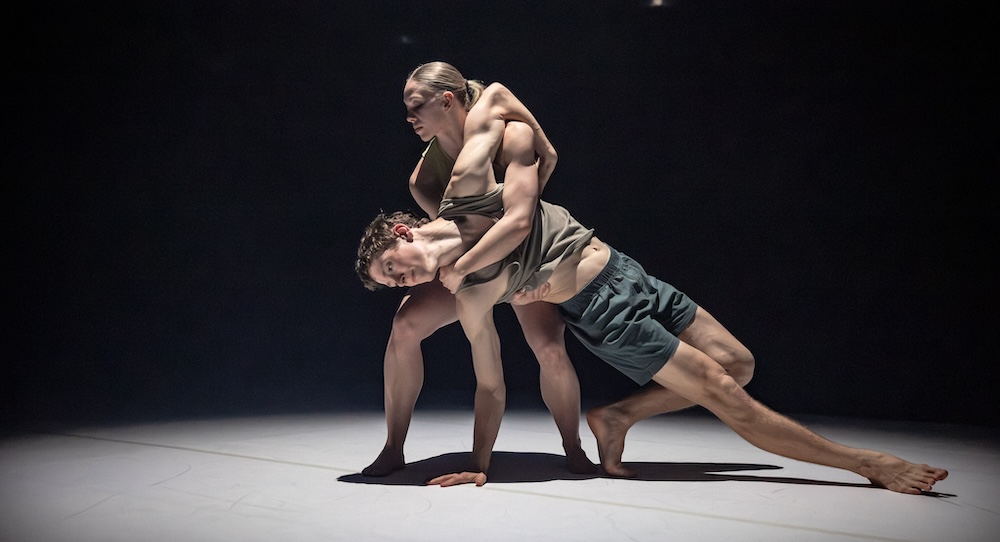
Performed by Jai Fauchon and Lucy Angel in this show (alt. Sam Winkler and Caiti Ellen Carpenter), E2 7SD immediately establishes a vocabulary of physical interdependence. The two dancers are rarely separate, continually holding, pushing, pulling, wrapping and counterbalancing one another. Their bodies absorb and redirect each other’s momentum in an ongoing exchange in which it becomes increasingly difficult to determine where one body ends and the other begins.
A recurring movement motif provides the work with its structural spine. Beginning upright and in close proximity, the dancers repeatedly return to variations of a shared physical configuration, changing orientation and level until a similar relationship is reproduced on the floor. The repetition creates a sense of routine and inevitability, as though the dancers are caught within a cycle that continually brings them back to one another.
There is an almost pendular quality to the choreography. One body initiates an action and the other responds, only for that response to propel the first dancer back into motion. Push becomes pull; support becomes resistance; tenderness becomes tension. At times the relationship is gentle and intimate, at others it carries an unmistakable aggression. Yet the two remain inseparably connected.
Angel and Fauchon are exceptionally well matched, possessing the strength, flexibility and physical trust required to make the choreography appear almost effortless. Their continual counterbalancing gives the work its kinetic intensity, creating the impression of a single physical system constantly recalibrating itself.
The sense of history embedded in E2 7SD is particularly resonant given Bonachela’s impending departure from Sydney Dance Company’s artistic directorship. Revisiting a work that marked such an important point in his own career creates a quietly circular gesture: a return to the moment when he established himself independently as a choreographer while simultaneously looking towards whatever comes next.
If E2 7SD explores the relationship between two bodies, Jenni Large’s Alpha Mutt expands the question into the dynamics of a group. Its territory is obedience, dominance, submission and control, using the dog as a metaphor for the complicated ways humans organise themselves around power.
Large moves between extremes. Slow motion and explosive dynamism sit alongside one another; bodies move vertically before collapsing to all fours; meticulous control suddenly gives way to something more feral. The shifts are dramatic but never feel arbitrary. Instead, the choreography continually tests the boundary between restraint and release.
The movement vocabulary is striking. Individual body parts appear to operate independently, producing small pulses, isolations and sudden shifts that accumulate into larger phrases. Feet strike the floor rhythmically, bodies suspend and twitch, and movement seems to travel through the dancers in waves. There is a sensuality to the work, but it is never gratuitous; a confrontational edge, but without the feeling of trying too hard to provoke.
The costumes similarly inhabit an ambiguous territory between high fashion and bondage, reinforcing the work’s fascination with bodies that are simultaneously controlled and displayed. Throughout, verticality becomes an important visual marker of power: who stands, who lowers themselves, who follows, who leads and ultimately who controls whom.
Large is particularly effective when she allows these dynamics to unfold slowly. Moments of counterbalance are held long enough for the audience to scrutinise the shifting relationships between dancers. A single individual can appear to command the group, only for the hierarchy to rearrange itself. Control is never entirely stable.
The work’s most compelling question is not simply why people obey, but why obedience can itself be seductive. There can be comfort in knowing the rules, pleasure in synchronising with others and security in surrendering individual agency to a collective structure. Dance itself is built upon these contradictions: dancers submit to extraordinary discipline, repeat and refine movements, synchronise and follow instructions. Large turns that familiar choreographic discipline into something more unsettling, asking when repetition becomes ritual, when ritual becomes rule and when a rule becomes unquestionable.
Azzam Mohamed’s OUR(SELF) shifts the focus from hierarchy towards individuality, community and shared experience. Inspired by the idea of a space where people can arrive exactly as they are, Mohamed builds the work around individuality rather than uniformity. Drawing on Hip Hop, Popping, House, West African dance and Afro House, the choreography allows distinct movement languages to coexist while gradually creating a shared rhythm.
What is particularly enjoyable is the dancers’ obvious pleasure in performing it. The work feels less like a demonstration of technical virtuosity than an invitation to participate in the energy of the space. Clearly choreographed and synchronised passages sit alongside moments of apparent improvisatory freedom, producing what might best be described as organised chaos.
There is an important tension here between individuality and belonging. The dancers are encouraged to bring their own histories, physicalities and movement languages to the work, yet they are continually finding ways to listen and respond to one another. Difference becomes the mechanism through which connection is created.
There is a distinctly communal quality to the work. Dancers gather, watch one another, form circles and step forward into the centre. At times it resembles a sporting event; at others, a dance battle or spontaneous dance circle. There is competition, but it is playful rather than hostile. Dancers challenge and encourage one another in equal measure.
That duality is important. The performers want to be seen, but they also want to see each other. They compete, but they belong to the same team.
The work has a strong rhythmic identity, with movement frequently punctuated by stomping and percussive interaction with the floor. Motifs appear, disappear and re-emerge elsewhere, creating a visual conversation between dancers who may not even be physically connected. The effect is cumulative: one dancer’s gesture seems to trigger another’s response until the entire space becomes animated.
There is also a strong sense of theatrical play. From the opening moments, when a dancer appears to survey the space through imaginary binoculars, the performers seem to inhabit a world where watching and being watched are equally important. Dancers move through the space, gather together and repeatedly create new configurations, shifting between individual display and collective movement.
Raghav Handa’s ONE SONG brings the evening to its exuberant conclusion, turning its attention towards Sydney itself: its eccentricities, performers, outsiders, storytellers and exhibitionists. The result is a playful, exuberant work that feels like a celebration of the city’s unruly energy and the traditions that emerge from it.
The final work carries an increasingly euphoric quality. There is something almost uninhibited about the dancing as the work develops, as though the performers have been given permission to let go. The technical ability of the dancers remains evident, but it is their sense of abandonment and sheer enjoyment that becomes most striking.
The atmosphere is heightened by the music, haze and physical intensity. There is an almost Middle Eastern quality to sections of the soundscape, and an atmosphere that initially suggests something darker and more decadent before transforming into a kind of collective release.
Dancers come close to the audience, moving beyond the edge of the performance area and at times draping themselves over the stage directly in front of us. In the Neilson Studio, this proximity is powerful. There is no protective distance between performer and spectator; the audience is close enough to feel physically enveloped by the energy.
Yet the apparent abandon remains carefully controlled. There are clearly choreographed and synchronised sections alongside moments that feel improvised and individual. Dancers shake out their hair, lose themselves in movement and appear to surrender to the rhythm, while the overall structure remains cohesive. It is organised chaos rather than chaos itself.
The result is a work that feels like a collective release—a group of highly trained dancers allowing themselves to dance with genuine freedom and pleasure. It is a fittingly euphoric end to the evening and one that fully deserved the ovation it received.
This progression ultimately gives Current its strength. Across four very different works, relationships are continually being negotiated: between two people, between an individual and a group, between performer and audience, between tradition and innovation, and between the past and future of contemporary dance.
The four choreographers occupy distinct territories. Bonachela’s physical architecture, Large’s examination of power, Mohamed’s celebration of individuality and Handa’s exuberant engagement with Sydney’s cultural character all have their own identities. Yet the works speak to one another remarkably well.
There is a pleasing progression through the evening: the concentrated physicality of a duet expands into the controlled tensions of a group, opens outward into playful competition and community, and finally erupts into collective euphoria. Ideas of rhythm, repetition, physical exchange and shared experience recur throughout, appearing in different forms without making the works feel repetitive.
And perhaps that is the most fitting way to mark 40 years at the Wharf. Current does not attempt to define contemporary dance. Instead, it demonstrates what it can be: intimate, visceral, confrontational, playful, culturally specific, physically demanding and, ultimately, communal.
By the time ONE SONG reaches its euphoric conclusion, the dancers seem to have shaken off every remaining inhibition. The technical precision is still there, but it is no longer the thing being foregrounded. What remains is the pleasure of movement itself—the sensation of bodies moving together, performers enjoying the freedom of the space, and an audience close enough to feel that energy.
It is a fittingly generous conclusion to a program celebrating four decades of dance at the Wharf: four perspectives, four distinct physical languages, and one continually shifting Current.
By Linda Badger of Dance Informa.