
Drama Theatre, Sydney Opera House.
24 June 2026.
Sydney Dance Company’s latest triple bill, Engine, is less concerned with movement itself, than with the invisible forces that propel it. Across three remarkably different choreographic voices, the evening becomes an exploration of human connection: how we love, how we belong, ad how we find meaning through the journeys we undertake together. While the return of Melanie Lane’s Love Lock, Fran Diaz’s Australian premiere of The Mass Ornament, and Rafael Bonachela’s world premiere The Journey Itself Is Home occupy vastly different aesthetic spaces, each asks what it means to exist simultaneously as an individual and as part of something larger.
Perhaps most striking is the maturity of Sydney Dance Company’s current ensemble. These dancers are not merely exceptional technicians; they have developed a collective confidence that allows each work to breathe with authenticity. Whether navigating Lane’s imagined rituals, Diaz’s relentless geometric structures, or Bonachela’s deeply human reflections, the company demonstrates a remarkable ability to inhabit vastly different choreographic languages while maintaining an unmistakable sense of artistic identity.
Returning to Sydney after a successful European tour, Melanie Lane’s Love Lock feels richer and more assured than when it premiered in 2024. Inspired by iconic love songs across generations and the communal traditions they carry, Lane imagines a speculative folk ritual that exists somewhere between memory and fantasy, celebrating love not as sentimentality but as a force that continually reinvents itself.
The work opens in near stillness. Birdsong-like whistles emerge from the ensemble, creating an atmosphere reminiscent of dawn awakening over an ancient landscape. Suspended lighting structures descend from above, their shifting configurations mirror the choreography’s continual evolution, subtly reinforcing the work’s themes of connection and transformation.
A quiet solo, reflecting a bird-like mating dance, gives way to the full ensemble, and from that moment the work seems to switch on. Dancers pulse, pose, and weave intricate formations that surge across the stage like rolling tides at times, processional pathways dissolving into intersecting lines before reforming again. Lane’s movement language cleverly merges references to folk dance, communal celebration and contemporary high fashion. At times, the performers appear almost ceremonial; at others they command the stage with the deliberate confidence of a couture runway. The juxtaposition is unexpectedly compelling, suggesting that ritual itself continues to evolve within contemporary culture.
Akira Isogawa’s extraordinary costumes are integral to this world-building. Richly textured with feathers, flowing fabrics and sculptural silhouettes, they evoke folklore, mythological creatures and imagined futures simultaneously. Each costume carries its own distinct identity while contributing to the larger visual landscape, reinforcing individuality flourishing within collective experience.
What is perhaps most rewarding in this revival is witnessing how completely the dancers now own the work. There is greater clarity, confidence and commitment than in its original season. Rather than performing choreography, they appear to inhabit a shared mythology, each artist fully invested in the fictional world Lane has created. The result is a work that no longer feels exploratory but entirely realised.
If Love Lock celebrates our desire for connection, Fran Diaz’s The Mass Ornament examines the complex relationship between individuality and conformity with astonishing intellectual and physical rigour. The Berlin-based Spanish choreographer’s Sydney Dance Company debut is an uncompromising thirteen -minute work of relentless momentum, drawing inspiration from Siegfried Kracauer’s influential 1927 essay analysing synchronised dance as a reflection of modern capitalist society.
Yet Diaz’s choreography does something far more interesting than simply illustrating Kracauer’s ideas. It questions them.
Dressed in olive-green satin pyjama-like costumes and black sneakers, the dancers inhabit a strangely unsettling world. Their wet hair amplifies the dynamic force of every movement, while Henryk Górecki’s score, augmented by Tom Foskett-Barnes, drives the choreography with mounting urgency. The aesthetic feels unmistakably European – not simply in its movement vocabulary but in its dramaturgy, its willingness to embrace ambiguity, repetition and psychological tension without explanation.
For 13 uninterrupted minutes, the ensemble hurtles through constantly shifting geometric formations. Triangles dissolve into diagonals, dense clusters fracture into fleeting duets before collapsing once more into collective order. The choreography does not allow stillness. Instead, it accumulates momentum until the audience experiences its physical intensity almost viscerally.
Yet beneath this extraordinary athleticism lies the evening’s most compelling intellectual proposition.
Kracauer’s original essay argues that modern society reduces individuals to interchangeable components within larger systems. Diaz begins from that premise but quietly dismantles it. Throughout the work, tiny variations of timing, intention and physical emphasis continually emerge within the larger choreography. These are not acts of rebellion against the group, but evidence that individuality is not erased by collective precision. Rather, it is revealed through it.
The ensemble becomes less a machine than a living organism whose success depends upon trust, awareness and mutual responsibility. Each dancer’s individuality becomes visible precisely because every performer remains acutely aware of everyone else.
It is a quietly radical proposition.
Contemporary culture frequently frames individuality and community as opposing forces. We are encouraged to define ourselves through distinction, to cultivate uniqueness almost as a personal brand, while conformity is often viewed as inherently oppressive. The Mass Ornament proposes something more nuanced. Serving something larger than oneself need not diminish identity; it may instead deepen it. The choreography suggests that genuine individuality flourishes not despite community but because of it.
It also evoked something deeply psychological. It’s relentlessness, explosive physicality and continual negotiation between control and eruption reflected the experience of anxiety itself: energy searching for release, thoughts circling without resolution, bodies caught between restraint and catharsis. Whether intentional or not, this emotional resonance gives the work extraordinary depth beyond its conceptual framework.
Remarkably, the philosophical trend introduced by Diaz continues into Bonachela’s The Journey Itself Is Home. Where The Mass Ornament explores our place within the collective, Bonachela reflects upon a life shaped through relationships – with collaborators, with community and with the experiences that ultimately define us. Identity, in both works, is never discovered alone.
Created in collaboration with Grammy Award-winning composer and long-time collaborator Bryce Dessner, and inspired by the writings of 17th-century Japanese poet Matsuo Bashō, The Journey Itself Is Home feels deeply personal. Knowing that Bonachela has announced his departure as Artistic Director after seventeen transformative years inevitably colours the viewing experience. The work carries the quiet weight of reflection, as though considering not simply where a life has arrived but everything encountered along the way.
The partnering throughout is among Bonachela’s most inventive. Bodies support, redirect and continually reshape one another through flowing architectural forms. Virtuosity never becomes an end in itself; every lift, every extension and every shared balance feels motivated by relationship rather than spectacle.
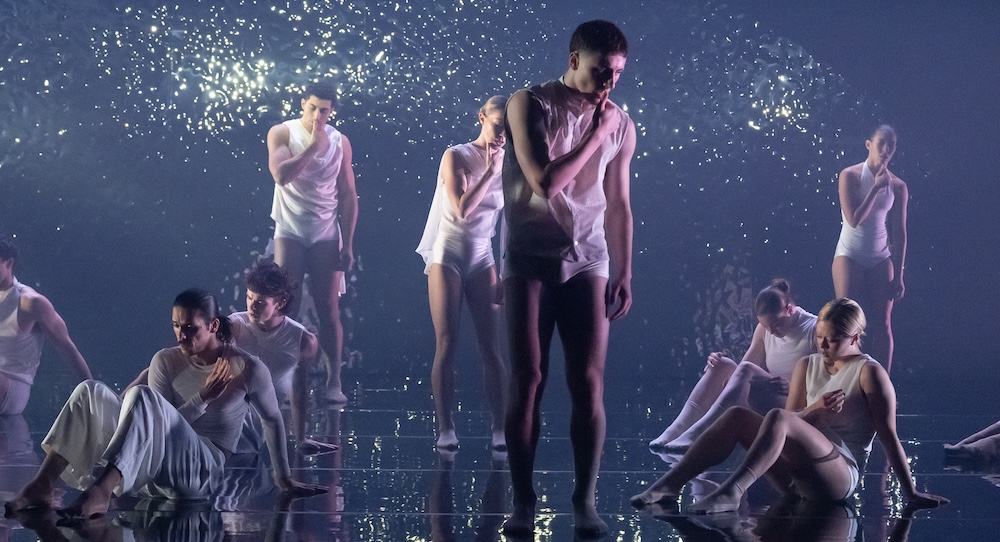
Kelsey Lee’s reflective metallic set, illuminated by Damien Cooper’s sensitive lighting design, creates shifting impressions of sunrise, moonlight and sunset without ever becoming literal. The dancers, dressed in varying shades of white and ivory, seem almost luminous within this changing landscape, echoing Bashō’s poetic reflections on impermanence and the natural world.
The title gradually reveals its profound simplicity. Home is not presented as a destination waiting to be reached, but as something continually created through the act of living itself. The choreography unfolds almost like both the arc of a single day and the arc of an entire life: tentative beginnings, flourishing, moments of uncertainty, renewed purpose and, finally, an ending that arrives without warning.
When the stage suddenly falls into complete darkness mid-movement, the effect is breathtaking. There is no final pose, no grand conclusion, only the reminder that life rarely announces its ending. Meaning resides not in where the journey finishes but in the journey itself.
As a complete evening, Engine demonstrates Sydney Dance Company performing at an exceptional artistic level. More importantly, it presents three works that continue speaking to one another long after the curtain falls. Lane celebrates the rituals that bind communities together. Diaz reveals that individuality flourishes through collective purpose rather than in opposition to it. Bonachela reminds us that home is ultimately created through relationships, memory and shared experience.
Together, they suggest that the greatest engine driving human life is neither ambition nor achievement, but connection.
By Linda Badger of Dance Informa.