
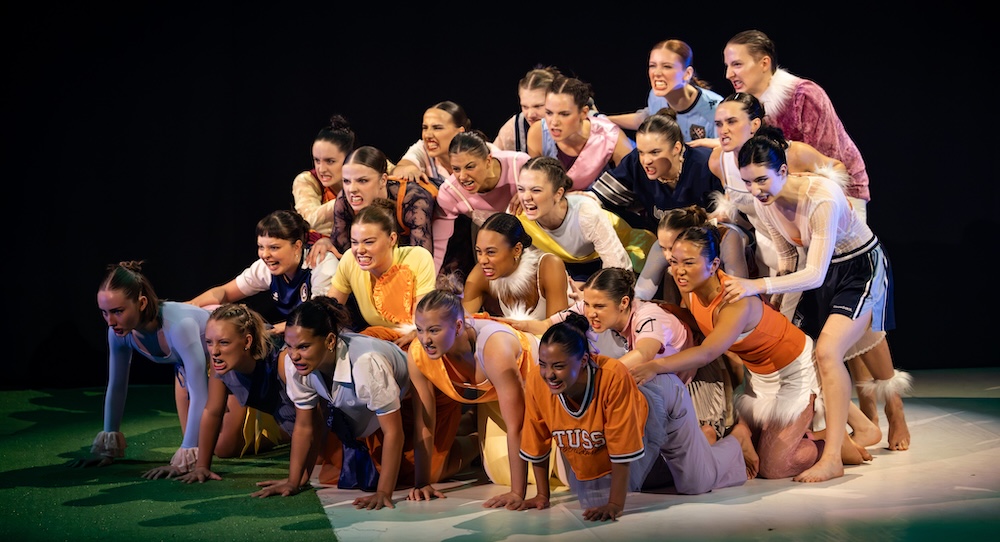
Sydney-based choreographer Emma Harrison isn’t brand new to the scene, but she’s certainly on the rise. She was recently given large exposure in Sydney Dance Company’s INDance program this past April/May, when she presented her work, High Octane. Here, Dance Informa catches up with Harrison and finds out about her choreographic process and what lies ahead.
I’ve followed your work since those early Sydney Fringe days, and one thread has remained remarkably consistent – the experience of women. Yet, each work seems to tackle it from a completely different angle. Has the question you’re asking changed over the years, or have you simply found new lenses through which to explore the same conversation?

“I actually don’t think I ever set out to make work about women. When I started making work, I was really just dancing to make sense of myself, and a part of that is existing in the world as a woman. Gender became the starting point because it was my lived experience, but over time I’ve realised I’m actually interested in something much broader.
Ultimately, I’m interested in unpacking systems (gender, class and power) and how they shape the ways we survive and exist in the world. The question has become less about women specifically and more about transformation: how people transform themselves to survive, belong, grow, gain power or navigate systems that weren’t built for them.
I watched myself do that. I’ve watched people throughout my life do that. It’s not a uniquely female experience, but it was my entry point into thinking about those bigger ideas. I ask myself all the time why I make dance. Why should this work exist? Why should audiences see it? Those questions keep me accountable to what I’m making. If I’m asking audiences to spend an hour with me, I want there to be a reason beyond simply making another dance work.”
Your upbringing features strongly in your biography, moving around regional Australia before eventually settling in Sydney. I’m curious how that nomadic childhood, and particularly your connection to regional Australia, continues to shape the worlds you create on stage.
“Dance became the constant in my life. We moved around so much that schools changed, friends changed and everything else changed, but ballet was always ballet. It became my anchor because wherever we lived, I knew that world.
I also come from a working-class family. There weren’t artists around me growing up. My family don’t naturally go to contemporary dance – they’ll come because I’m in it, or they’ll see something they already know, but they wouldn’t usually choose contemporary dance. That influences how I make work.

I genuinely think about whether my aunt and uncle would come and see something I’m creating. I want to make contemporary dance feel welcoming to audiences who don’t think it’s for them. I want to un-elite it. If people who have never stepped inside a theatre can come along, enjoy themselves, see themselves and then leave thinking about something bigger than themselves, that’s incredibly exciting to me. Art shouldn’t only speak to people who already know how to watch contemporary dance.”
One thing I’ve always admired in your choreography is your ability to move an audience from laughter to complete silence in a matter of moments. Humour seems to become a Trojan horse for something much more confronting. Is that something you consciously construct, or does it emerge naturally through your process?
“I love that description of humour as a Trojan horse because I think that’s exactly what it is.
Part of it is just who I am. I’m naturally quite goofy, and over time I’ve learned not to censor that part of myself. Sometimes I’ll walk into rehearsal with a completely ridiculous idea, like asking everyone to stand in a pyramid and growl as a choir, and we’ll just try it.
But comedy also gives us permission to approach things that might otherwise feel unbearable. If I tell people I’m making a work about power, capitalism or class, that’s a pretty heavy invitation. People naturally protect themselves from conversations like that. Humour lets audiences lower their guard.
Comedy and tragedy are incredibly close. If you don’t laugh, you cry. The laughter creates space for audiences to stay open, and then suddenly they’re engaging with ideas they might otherwise resist. That’s really important to me because I don’t want people to walk away feeling lectured. I want them to feel invited into the conversation.”
Your works are wonderfully quirky, but beneath that eccentricity there’s an incredible precision. What does your choreographic process actually look like? Do you begin with movement, images, tasks, text, or something else entirely?
“It nearly always starts with a vision. Some sort of strange apparition I must bring to life.
With Top Dog, for example, I could immediately see a pyramid of dancers growling. Only afterwards did I start asking why that image had appeared, and realised it was about competition, pageantry and power.

From there, I research obsessively. At the moment, I’m thinking about cane toads, invasive species and endometriosis – how things become embedded within systems and quietly change them from the inside. I’ll collect images, articles, ideas and conversations before I even know what the work is.
I always describe the process as tie-dyeing a sheet. You gather all these different colours, tie everything together, and only when you unravel it do you discover what you’ve actually made.
Then I bring collaborators into the room. I tell them everything I know about the world we’re creating, and then I ask what they know. We throw everything into the soup together. Sometimes we’ve accidentally made chocolate for the minestrone, but that’s part of the process, too.
Movement is part of the world research, too. I’ll start dancing, trying things physically and discovering what kind of movement language belongs in that world.”
You’ve developed such a distinctive artistic voice over the past several years. Was there a point where you realised you no longer needed to make work that looked like anyone else’s, that you’d found ‘Emma Harrison’ as a choreographer?
“I think it happened when I stopped worrying about whether what I was making looked enough like contemporary dance. For a long time, there’s been this idea for me that contemporary dance had to be serious and beautiful. I realised that isn’t how I think about the world. I wanted to sing. I wanted people to talk. I wanted comedy. I wanted absurdity. Sometimes an idea becomes movement, and sometimes it becomes something completely different. I eventually trusted that instinct. Maybe some people won’t call it dance, and I’m super okay with that. I’m interested in making a show that communicates with people, whatever form that takes.”
Looking ahead, what feels like the next frontier for you? Is there a work, collaboration or scale of project that you’ve been quietly dreaming about but haven’t yet had the opportunity to make?
“I definitely want to keep making my own work. There’s a project I’m developing around cane toads and invasive species that I’m really excited about, and I’ve also just finished developing a work for primary school audiences.

Beyond that, I’d love to create work on a larger scale, make a commission for a large company. As an independent artist, it’s hard to work with large casts or on big stages, so being able to bring my practice into those spaces would be incredible.
I also love collaborating, so I hope I’ll always continue performing in other people’s work as well.”
If you could influence one thing about the Australian contemporary dance sector over the next decade, what would you most like to see change?
“I’d love to see greater access both for artists and audiences. I’m worried that the sector is becoming more homogeneous because it’s becoming increasingly difficult for people from working-class backgrounds to build sustainable careers. If only people with financial security can afford to stay in the arts, we’re going to lose an enormous range of stories and perspectives.
I’d also love to see more appetite for risk. Different voices making work for different audiences only strengthens the sector. Contemporary dance shouldn’t feel exclusive. It should feel like something everybody is welcome to experience.”
Finally, when audiences look back at your body of work years from now, what do you hope they recognise as the thread that connects it all?
“I hope they leave thinking about something slightly bigger than themselves. Maybe it’s only one step outside their own perspective, but that’s enough. I’d love people to question inherited stories, question systems, question where they fit in the world and maybe think, ‘I’d never looked at it like that before.’
But I also hope they had a good time…Joy is just as important as grief. You can’t understand one without the other, and I never want audiences to feel like they’ve simply sat through something heavy. I want people to laugh, to feel entertained and then, maybe on the way home, realise they’re still thinking about the questions the work left behind.”
And now for some quick answer questions if you would oblige me…
The best creative advice you’ve ever received?
“Don’t put a hat on a hat. Meaning if it’s saying the thing, let it say the thing. Don’t add something that’s saying the same thing for the sake of adding it.”
What’s one word your dancers would use to describe rehearsals with you?
“Chaotic or loud.”
If you weren’t a choreographer, what would you be doing?
“Definitely something in the arts – probably film or theatre direction! I would need to be doing something where I can utilise my weird and my body.”
The weirdest thing that’s ever sparked a dance idea?
“I made a work called Fever Dream and it was sparked after going to see the karaoke singers at Covent Garden pub in Chinatown. They were so incredibly fearless and intentional, and I just found it so inspiring, so I made a work where we sang/danced this weird, absurd, broken up version of ‘Bohemian Rhapsody.’ It was wild!”
By Linda Badger of Dance Informa.