
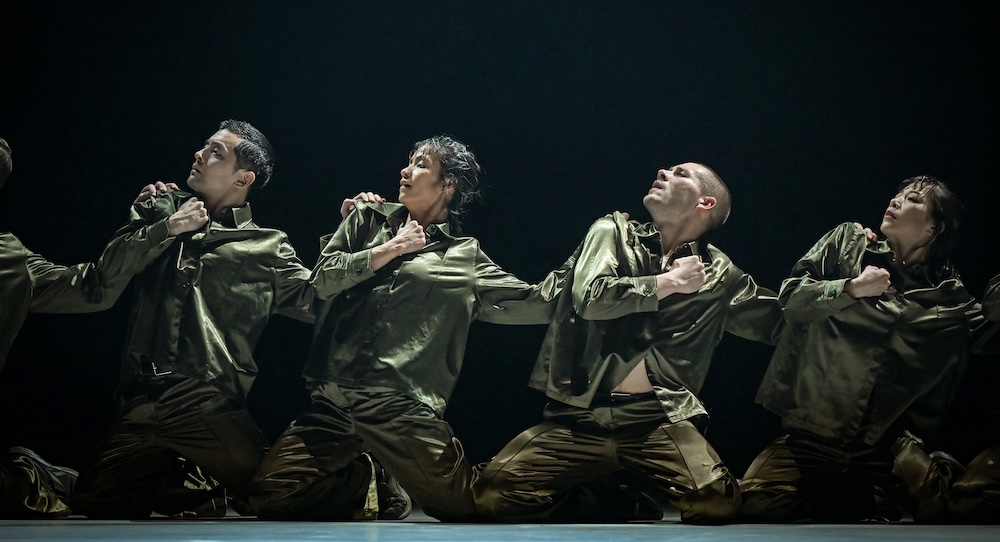
Berlin-based choreographer Fran Diaz is known for creating works that examine collectivity, power and the systems that shape human behaviour. For The Mass Ornament, making its Australian premiere with Sydney Dance Company at the Sydney Opera House this June and July, Diaz draws on cultural theorist Siegfried Kracauer’s influential 1927 essay to explore the tension between individuality and collective action in contemporary society. Ahead of the premiere, Diaz spoke about the ideas behind the work and the surprising discoveries that emerged during its creation.
What first drew you to Siegfried Kracauer’s essay The Mass Ornament, and why did it feel relevant to revisit nearly a century after it was written?
“Kracauer stated that we can look at popular cultural objects, sort of like dreams. We can interpret them as symptoms of a culture, and by analyzing them we can have a lot of information about the socio-economic context in which they were created. To prove his point, he used ‘The Tiller Girls’ as an example. The Tiller Girls were the element that really draw me in, and I felt the most fascinated about when conceptualising the piece. The troupe gained international popularity at the beginning of the 20th century for their highly trained and precise movement patterns. Their dance was often arranged in a line formation that constantly shifted into geometric patterns. It was an extremely mathematical and rationalized dance, with each one of these women a necessary part of a whole; each of them a crucial part in a very well-oiled machine. Kracauer drew parallels between the phenomenon of ‘The Tiller Girls’ in the late ’20s and ’30s with the consolidation of capitalism in America and the growth of mass production globally; he noted that by watching the intricate formations of The Tiller Girls, one could observe the perishing of individuality for the sake of the whole, a feature also very present in mass production processes and factory lines. Repetition, power, efficiency, precision, and rationalization of movement, where all qualities necessary to maximize productivity and qualities that could also be found in the troupe’s dances.

I was intrigued by the idea of recreating a human mass artifact that would reference and rely on these qualities, while keeping a few questions in mind: What would an object of our contemporary time look like? When creating such a choreographic device can we, as viewers, be aware of the part without sacrificing the whole? When referencing The Tiller Girls, can an emotional depth still shine through? Can we see the affection? Anger? Love? Can we still catch glimpses of the personality of each of its components?”
The work appears to question how individuality operates within larger systems. Did your perspective on individuality change during the creation process?
“It sort of did. The most striking realization for me was that what carries the piece is not necessarily what is visible, but what lies underneath it. There was no loss of individuality or personality; rather, an entire system of care, awareness, trust, and collaboration revealed itself in the process of bringing this complex choreographic device to life.
I began to understand that the strength of the work (or at least what feels most important to me within it) does not really lie in the obvious elements: the steps, the structure, or even the synchronicity. What matters more is the amount of collective care, understanding, communication, and attention required to sustain it. The way each individual supports, holds, and elevates the others in order to make the structure possible.”
Many of your works seem concerned with what lies beneath the surface of organised systems. What do you think dance can reveal that other art forms cannot?
“Dance is a deeply human art form. Unlike film, sculpture, or painting, dance (as any sort of performance) is created (or recreated) in front of us, in real time, by another human being. There is something powerful about witnessing something so alive: a once-in-a-lifetime event that demands our attention because the next time it is performed, it will inevitably be different, as it is human, after all.
In my work, I am drawn to intricacy and structural choreographic complexity. I am interested in what happens when a group of dancers gather together to perform complex, delicate systems in front of an audience. Even when this is their job, there is something profoundly hopeful in watching them do it.
We live in a complex world. Our lives, and the systems we inhabit, are equally intricate. I think to witness bodies navigating complexity together can feel meaningful and vital. I think it suggests: if they can do it, perhaps we can, too.”
Please describe your creative process for this work.

“In general, beyond the conceptual framework, my creative process in the studio is always based on collaboration. There are certain stylistic codes that I try to transmit to the dancers, but I want them to function more as tools than as restrictions. Ideally, they open up different possibilities of expression rather than limiting them.
For me, it is important to establish a dialogue, even if it is not always verbal, and to find the core of the people I am collaborating with: who they are, what they can bring to the work, and where their input and mine intersect. I am also constantly reminding myself to stay playful throughout the process.
For this specific work, I was searching for the right canvas for the ideas I was exploring through Kracauer’s essay. Then a friend sent me a live recording of Górecki’s Harpsichord Concerto, and I immediately felt it was the perfect companion for those ideas. The music felt relentless and romantic at the same time, both obtuse and accessible. It carried an overwhelming, almost punk-like energy, and once I decided to incorporate it into the work, it became very easy to follow its lead.”
Were there moments in the rehearsal process where the dancers themselves changed your understanding of the ideas behind the work?
“I think it’s important for me to begin with a strong conceptual foundation and prior research, but once you’re in the studio, you also need to let go of that structure enough to remain open to what is actually happening around you. I try to keep this in mind throughout the entire process: to stay present with the dancers and allow them to lead me somewhere unexpected as well.
In the case of The Mass Ornament, what could have simply become a large ensemble piece gradually shifted into something less rigid and more chaotic because I became curious about getting to know the performers more deeply. When you are working in a studio with 17 people and only a limited amount of time to create something, it becomes difficult to connect with each person in the same way. That’s why I decided to introduce many solos, duos, and small groups into the process.
I realised that I needed individual time with each dancer in order to understand the essence of who they were and where their strengths lay. From there, it became much easier to understand what kind of energy the more structured and synchronised second half of the work needed, so that all of their individual qualities could still remain visible within the ensemble.”
Many audiences might assume that strict unison suppresses individuality. What does individuality actually look like within the choreography of The Mass Ornament?
“In The Mass Ornament, my goal was for the performers’ individualities to remain present both in the solos and in the group sections. I don’t think the assumption that strict unison suppresses individuality is entirely accurate. Collective precision requires trust and interdependence.
Of course, there are always individual compromises involved in making a collective structure work. But for me, compromise does not necessarily mean suppression. The key question is how to create the right environment so that different individualities can support, affect, and elevate one another through the process.
In that sense, the choreography reveals a deeper layer of relations. It raises questions such as: what does each person adjust, negotiate, or give up in order for the group to function? Those questions were important to me. I am less interested in the perfect image on stage than in the invisible network of individual relations that makes that image possible.”
This production is being restaged with Sydney Dance Company dancers for its Australian premiere. How might this work change when it is translated to a new company, a new group of performers, and a new cultural context?
“Restaging a work with new dancers is always exciting. I see it as an opportunity to breathe new life into it, to discover new possibilities, or even uncover new structures. For me, restaging is about preserving the essence of a piece rather than reproducing it exactly. If every element were to remain the same, I wouldn’t find much interest in the process.
The work was recently restaged at Ballet National de Marseille in a completely new iteration for four dancers only, whereas the original version was created for 13. That experience felt like an entirely new exercise. The piece became something else altogether.
Now, working with Sydney Dance Company feels like another form of re-creation. In some ways, we are returning to conditions that are closer to the original, but with a completely different group of performers. I was especially struck by the dancers’ collective awareness, which is something very dear to me. They understand the physicality the piece requires in a very organic way, and they are incredibly nuanced in their dynamics. I’m very excited to see how it all comes together.”

What excites you about bringing the work to Australian audiences for the first time?
“Beside the conceptual framework, It is a highly energetic piece, so I hope Australian audiences can connect to its energy and hopefully be swept by it in some way.
I feel very grateful and excited, not only to bring my work to Australia, but also to have the opportunity to visit the country for the first time. Keren, my close friend, collaborator, and choreographic assistant, grew up in Noosa, so it feels especially meaningful that we are able to bring the work to Sydney and set the piece together there.
I believe this is also the first time she has had the opportunity to work professionally in Australia, since most of her dance career has taken place in Europe. In that sense, it feels quite special that this work is allowing both of us to come there together.”
After spending so much time examining systems, collectivity and human interdependence through this work, what is the single idea or question that continues to stay with you?
“It’s not so much a conceptual idea that stays with me, but more a process-oriented one, although the two are obviously connected: No matter how complex what you are trying to achieve may be, you can always go much further when you lead from kindness, from love for your craft, and from respect for the people you collaborate with.”
Sydney Dance Company will present Fran Diaz’s The Mass Ornament as part of triple bill Engine, from 24 June – 12 July. For tickets and more information, visit www.sydneydancecompany.com/performance/engine.
By Linda Badger of Dance Informa.