
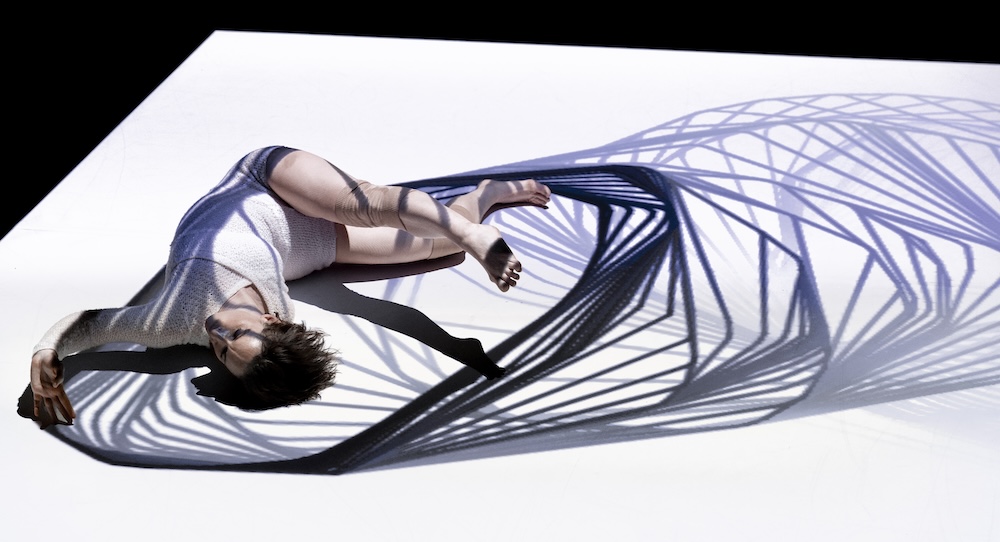
Chunky Move Studio, Melbourne.
May 28 2026.
Are we truly in control, or simply being sold the idea that we are?
Case in point: the dancer. She moves, solo on a rectangular stage. As she does, light and sound are triggered by her movements, tracing the choreographic flow of her form. Yet, as we watch, she writhes, a creature in pain, her body stretched and flung like a marionette. If this is indeed a dialogue between woman and machine, it scans more like a twisted duet of prisoner and torturer.
The lore of Chunky Move’s Glow speaks of motion tracking gadgetry, of dance and tech syncing to create a work that became Australia’s most toured contemporary dance show. Now, 20 years on, original cast member Sara Black returns to recreate her career-making role as part of the inaugural Dance Biennale at Melbourne’s RISING festival.
However, more than nostalgia, Glow 2026 lands in the midst of yet another digital storm. As we wrestle with the emerging phenomenon of AI, and fret about the next iteration of machine dystopia, Gideon Obarzanek’s startling and beautifully illuminated vision feels even more apt.
That Obarzanek’s relatively straightforward choreography is matched so precisely with Frieder Weiss’ ingenious media overlay and the sound design of Luke Smiles is part of the spectacle. From a production perspective, Glow still looks great. Actually, startling.
Yet, step back from the PR blurbs and official histories, and what we have is a lone figure in an immaterial landscape. A body somehow incorporated into a world that looks like graphic design. A book cover. A promo poster.
However, the longer it goes, the more she begins to resemble a lab rat, or a thought criminal in a featureless cell being electrocuted by an invisible inquisitor. She struggles, cries out, but no one responds. The robot vivisector does not register her suffering.
But wait…her anguish is being monitored. By us. As we sit, slightly elevated, surrounding her, looking down on her.
There is an argument to say that Glow is a one trick pony — more production value than artistic merit. This misses the point. The tech here is a storytelling tool. It creates a visually pleasing journey, a sugar hit of light and shape, but it strikes with greatest effect on the still open wound of our not-so-secret terror. Namely, that we do not have free will; that we do not have control.
The pretty lights may well shine on the supple dance body of Sara Black, and we may hoot and holler when she’s done, but the aesthetic aura is the mask of the god/machine/despot. The choreographer who tells us what move comes next and then says, make it your own.
Metaphors aside, Chunky Move’s Glow is rightly hailed in this country and beyond. At once simple and multi-layered, easy on the eye and discomforting, it has survived the gap of two decades and retained a dazzling relevance as both pure dance and profound investigation.
By Paul Ransom of Dance Informa.