
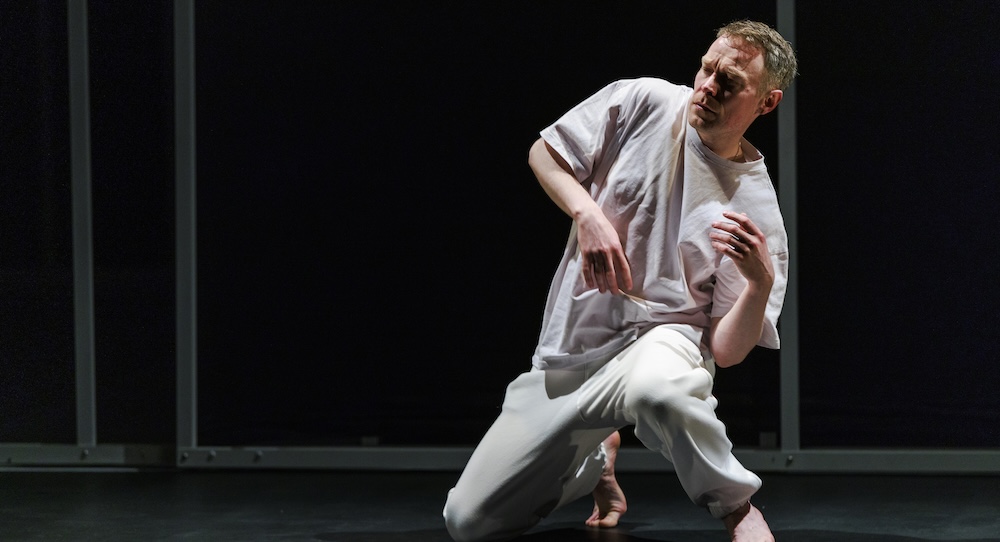
Merlyn Theatre, Melbourne.
27 May 2026.
Oona Doherty’s ugly/beautiful ode to the Ulster capital is one of the most affecting dance works I have ever seen. With its blend of mid-century social realism, high art stylings, and physical theatre, it immerses us in the self-defeating honour culture of a city riven by sectarian warfare and rusted by decades of both real and perceived decline. But more than that, as someone who grew up in a working class migrant suburb, Hard to be Soft rings true.
I lived amongst the crass hormonal boys, the ones playing it hard, the ever-suspicious policers of maleness, whose badges of manhood were alcohol, violence, and treating their girlfriends like shit. Yet, Doherty does more than evoke the proletarian cliché or allow us to sit smugly in bourgeois judgement. She moves us into the deeper sadness. These are lives confined. Hemmed in by failing industry and narrow horizons. People who survive in a world where it is nigh impossible to be soft. Where people do not typically aspire to the making of theatre.
Driven by an evocative and scene-setting voice track, and underscored by the music of DJ David Holmes, Hard to be Soft transports us to a grim corner of Belfast, where a Hobbesian war of all against all is in progress. In four distinct chapters, it unfolds visions of incarceration and resistance.
This effect is amplified by the superb production aesthetic. The set evokes both avant-garde art and Brutalist facades. Lighting and projection are used deftly, giving the work a sometimes surreal over-glow. It is a disturbing synthesis, like a cruelly arranged marriage between elegant design and senseless, monolithic tyranny.
Peeling further layers, we find the sly joke, the disguised barb. Doherty has made a work of complex, nuanced art, one beloved of its mostly well-heeled audience, and praised by critics in publications that people in the rough house neighbourhoods of Belfast (and elsewhere) never read. In this, something vital. Doherty is not looking down from a cultured distance. Rather, she is fashioning a form of uplift. A lifeline thrown by art.
We see this in the choreography, which veers continuously from dance to mime to narrative acting. When two shirtless men move between pas de deux and wrestling, and a group of young girls segue from pre-match huddle to Haka-like war dance, we witness the blurring of easy distinctions.
Indeed, we can say likewise for the work as a whole. Hard to be Soft is more physical theatre than contemporary dance. It recalls early twentieth century practitioners like Brecht and channels the post-WW2 British New Wave. Overall, it scans like a more figurative form of documentary or verbatim theatre. As though, by some trick, we are hallucinating the real.
Few dance works have evoked such personal connections for yours truly. Though I will not pretend that my outer suburban childhood in ’70s/’80s Adelaide mirrored the civil war and industrial decay of Belfast, Doherty has distilled something essential about class, gender, and futile notions of honour and identity. She took me back, not just to my upbringing but to the tales told by my parents about how little room to move they once had. Until, like the lady says in Hard to be Soft, they took the plunge and moved to Australia.
Thus, the Belfast prayer that Doherty alludes to in her title may well be something as simple and profound as, get me out of here.
By Paul Ransom of Dance Informa.