
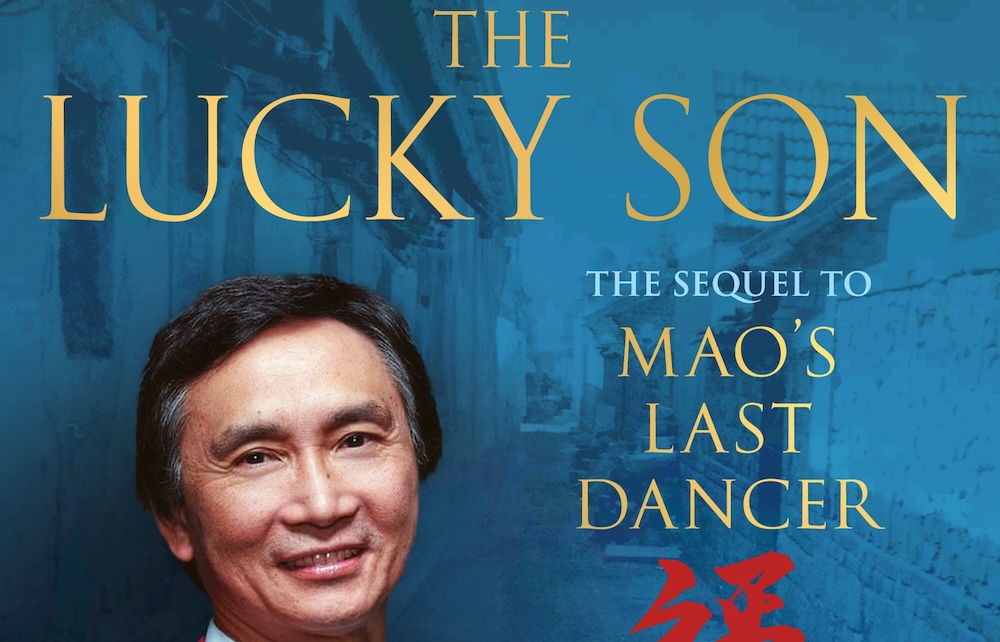
Book: The Lucky Son
Author: Li Cunxin, Penguin Random House, October 2026.
There is something particularly satisfying about reading The Lucky Son after revisiting Li Cunxin’s Mao’s Last Dancer and, alongside it, reading Mary Li’s Mary’s Last Dance. None of these books was intended to form a trilogy, yet together they create something remarkably close to one. Each adds another perspective to an extraordinary, shared story, and The Lucky Son provides a fitting continuation of Li Cunxin’s journey.
I have been absorbed in these books over the past few months, and what has struck me most strongly is not simply Li’s extraordinary career as a dancer, but the resilience, adaptability and sheer force of character that have carried him through every stage of his life. His indomitable character seems to ooze from every page.
Mao’s Last Dancer tells the extraordinary story of a boy born into extreme poverty in Mao’s China who is selected to train at the Beijing Dance Academy. Taken from his family at just 11 years of age, he initially hated ballet and struggled with the separation, the brutal training and the difficult living conditions. Yet, through a combination of opportunity, determination and an almost extraordinary capacity for hard work, he eventually became a principal dancer with both Houston Ballet and The Australian Ballet.
The Lucky Son picks up the story after that remarkable escape and success. Without knowing his first story, it would be easy to look at Li’s life and see an almost charmed progression: international ballet success, marriage, children, celebrity friends, wealth, major productions and eventually the artistic directorship of Queensland Ballet.
But this book makes it clear that success has never come easily.
Li’s life is defined by his ability to meet adversity head-on. Family challenges, illness, professional disappointments, natural disasters that threaten to ruin hard won progress, and COVID-19 all become part of the story. His response is remarkably consistent: assess the problem, find a way forward and keep going. That resilience is perhaps the defining quality of the book.
There is also a refreshing honesty to Li’s storytelling. He does not appear interested in presenting himself as heroic or in smoothing over the difficult parts of his life. He reflects on his decisions, relationships, failures and uncertainties with an openness that gives the memoir considerable emotional weight. There is very little guile in his storytelling; he seems genuinely interested in understanding his life rather than simply celebrating its achievements.
His relationship with Mary is central to this. Setback seems to strengthen rather than fracture them. Their desire to help Li’s family in China is particularly affecting. Despite the enormous difference between their lives in Houston and those of his family back home, they remain acutely conscious of where Li has come from and want to use their success to improve the lives of those they left behind.
The contrast between his two worlds is striking: rural China, where his family struggled simply to survive, and Houston, with its wealth, oil money and extraordinary opportunities. Suddenly, Li and Mary are attending major events, lavish parties, and meeting future US Presidents, Hollywood and theatrical royalty. Yet, beneath all of this remains the same person who understands what it means to go without.
Perhaps one of the most interesting aspects of The Lucky Son, particularly for young dancers, is that Li does not restrict his ambitions or his identity to dance. He understands that a professional dance career is finite and that dancers need to think about what comes next. His decision to learn stockbroking and develop another professional skill demonstrates remarkable foresight.
This is an important lesson. Li’s story is not simply one of becoming a successful dancer. It is a story about creating options. He embraces opportunities to learn, whether in the studio, in another country, in a different ballet company or in a completely different professional environment. His willingness to prepare for a career beyond the stage demonstrates that ambition can take many forms.
His transition from dancer to artistic director of Queensland Ballet is fascinating because we see how the experiences of his earlier personal and professional life culminate into something new. The discipline of his childhood, the relentless training at the Beijing Dance Academy, his experiences with Houston Ballet and The Australian Ballet, his stockbroking career, his understanding of people and his willingness to take risks all become part of his leadership style.
He sets enormous goals for Queensland Ballet and then works relentlessly towards them. Rather than accepting the limitations traditionally placed on a company of its size, he looks toward major international productions and asks why Queensland Ballet shouldn’t be capable of presenting them. His ambition is infectious, but it is not simply ambition for ambition’s sake. He cares deeply about people and wants dancers to achieve their potential and the company to grow, while being prepared to make difficult decisions when necessary.
The same indomitable spirit is evident throughout his personal life. What makes The Lucky Son particularly moving is the way Li and Mary face the challenges that come with building a family together. Illness, professional setbacks and the individual challenges faced by their children are not glossed over, but neither do they allow those difficulties to define them. Time and again, they pull themselves together, support one another and find a way forward.
There is a great deal of compassion in the way Li writes about his family. Each of their children has their own experiences and challenges as they grow into adulthood, yet Li and Mary remain present, adapting and learning as parents. Their family life is not portrayed as perfect, but as something they continue to work at with patience, love and an understanding that each person needs to find their own way. Watching their children grow into well-rounded adults is, in many ways, as satisfying as watching Li’s professional achievements unfold.
The book also places these deeply personal experiences alongside major moments in recent history. COVID-19, the Brisbane floods and the death of Queen Elizabeth II appear within the narrative, but they are never simply historical markers. They are experienced through the personal lens of Li, his family and Queensland Ballet, becoming part of the fabric of their lives.
The later chapters are particularly poignant as Li approaches the end of his tenure at Queensland Ballet and receives the Prix de Lausanne Lifetime Achievement Award. By this stage, the story has moved beyond professional achievement. Friends and family members pass, Mary faces her own enormous health challenges, their children grow into their own lives, and Li begins to look back on the extraordinary journey he has travelled.
At times, it can seem as though everything that follows Mao’s Last Dancer must simply be an extended account of success. But that is precisely what The Lucky Son proves wrong.
The first book tells us how Li escaped extraordinary circumstances and became a dancer. The second tells us what it takes to build a life after that escape – and how much resilience, adaptability, hard work, love and determination are required to sustain that life.
The title itself is revealing. There is certainly luck in Li’s story. He was selected for the Beijing Dance Academy. He encountered people who recognised his potential. He received opportunities that changed the trajectory of his life. But opportunity alone does not explain where he ended up. His great gift seems to be his ability to recognise an opportunity when it arrives and then work extraordinarily hard to make something of it.
Ultimately, The Lucky Son is not simply a book about ballet. It is a book about resilience and possibility. Li has lived through extraordinary poverty, professional triumph, family challenges, grief, illness, financial uncertainty and enormous responsibility. Yet his response, time and again, is to keep moving forward.
For dancers, particularly young dancers standing at the beginning of their careers, there is an especially powerful message here: dream big, work hard, take the opportunities that come your way — but don’t be afraid to build a life beyond dance as well. There is no reason that a dancer’s identity, ambition or future has to end when their performing career does.
The Lucky Son is ultimately a celebration of possibility. It is the story of a man who has reached heights that most of us could scarcely imagine, while retaining an extraordinary humility about the luck that helped him get there.
After reading Mao’s Last Dancer, Mary’s Last Dance and now The Lucky Son, I feel as though I have been given three interconnected windows into one remarkable life.
What a life it has been.
And what a reminder that resilience, curiosity, hard work and the courage to pursue another path can be just as important as talent.
By Linda Badger of Dance Informa.