
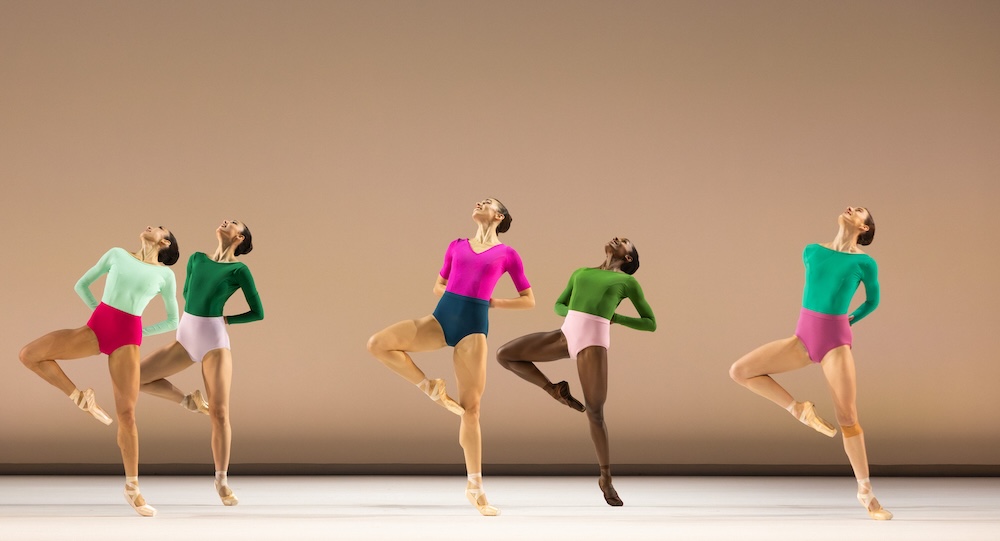
Regent Theatre, Melbourne.
23 June 2026.
For a work billed as ‘pure dance,’ it is hard not to read something more than a love of the artform into Justin Peck’s 22 part mosaic, Copland Dance Episodes. Indeed, its youthful energy and high tempo pacing – its sheer ebullience – hits like a bittersweet paean to hope. Moreover, a specifically American optimism. A dream that once drew millions from old worlds to the new, that looked so much like freedom and opportunity it lit a torch of modernity and progress that shaped a century.
The Australian Ballet’s production of Copland is the first outside its native New York, and its transplantation to Melbourne somehow serves to amplify the sense of both space and longing that beats at the core of the work. Perhaps, like America, this country also bears the legacy of once new frontiers, of abundance now crashing against limitation.
Set to the folksy cinemascope music of Aaron Copland, it evokes the modernist vision of the 20th century; namely, that tomorrow will be better. We begin with an open vista, like a wide plain, one that welcomes new arrivals. Their hope is intoxicating, like that of the young. Risk, vigour, discovery. Everything that keeps us airborne before the inevitable grounding of age.
Thus, bombastic heroism is given texture, is seen in the context of later revelation. Decline. As we journey through the continental breadth of Copland Dance Episodes, the lucid dream morphs to wistful nostalgia, verging at times on ironic kitsch.
What choreographer Peck and the team at The Australian Ballet have achieved here is a masterful repackaging of classic forms. Peck’s moves are (consciously, I suspect), ballet 1.01. Ellen Warren’s costumes mine Mondrian and pop art to conjure a colourful palette that makes the ensemble look more gymnastic than balletic. In counterpoint, Jeffrey Gibson’s set is beautifully utilitarian, its flat industrial surfaces somehow managing to give a sense of both city and sky.
Elsewhere, on stage and in the orchestra pit, echoes abound. Inter-war avant-garde, 1950s MGM grandeur, Broadway classics, the documentary photographs of Life magazine, the subtle yet seismic subversions of Yates and Plath.
And yet, somehow, amidst all the disinterred Americana, hints of fascist monumentalism and Soviet grandiosity. In other words, beneath sunlit liberty, the shadow of authoritarianism. The gravitational sense that the dream will yield to waking.
However, Copland Dance Episodes is also a straight-up dance delight. This is ballet stripped of tutus and fairy tale arcs, emancipated from the fusty old empires of inbred aristocrats and injected with a shot of multi-coloured youth. There is, in spite of the foreshadowed fall, a spring in its step. This is dance like hope was not irrational. Here, the classical lexicon dares to speak a new language; to say, your dream may have been a lie, so we will dream something new to replace it.
As an old man sitting in a theatre on a crisp winter night, I will confess to feeling the sun on my back, as though I too were still able to reinvent the world.
Who said ballet had a relevance issue?
By Paul Ransom of Dance Informa.