
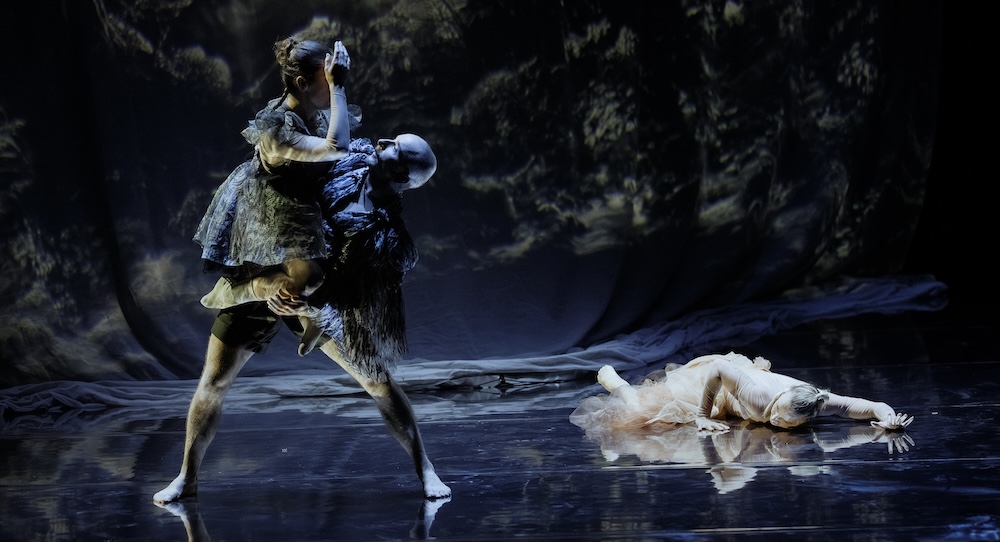
Union Theatre, Melbourne.
4 June 2026.
We have had a long, evolutionary relationship with forests. They have served as home, larder, and medicine chest, in addition to being a fount of myth, magic, and danger. That we have also seen them as sources of profit – as seemingly ‘free’ natural capital ripe for exploitation – is one of the rockier aspects of that relationship.
Melbourne-based choreographer Lucy Guerin and her ensemble of seven dancers lead us into the trees in their hallucinatory, folkloric ode to the complexity and power of these steadily dwindling ecosystems. The Forest, presented as part of the RISING Festival, is part fairy tale, part shroom trance, and part pagan ritual. Earthy, sensual, and spiritual, it evokes the damp fertility and symbiotic mechanics of an environment sometimes referred to as the wood wide web.
Underpinned by the mostly foggy (but sometimes frenetic) soundscapes of Mathias Schack-Arnott, it unfolds like a Gothic picture book. Under a dim, surveillant moon, we meet the forest creatures, the spirits and witches and wanderers who exist in a kind of mythic-real night. Here we dream, lifting the veil and transporting ourselves to other realms. At one point, we find ourselves ‘going off’ to psytrance at a bush-doof; modern primitives reconnecting with the deep roots of ancient arboreal landscapes.
Fleshing out the Grimm-esque noir, Guerin has crafted a movement palette that references growth cycles with a choreography that is both branching and vine-like, and where the repetitions are imprecise and organic rather than quantised and mechanical.
This imagery is expanded by the Eugyeene Teh’s set design; a world of reflections and veils that plays with the senses, edging into the surreal and psychedelic. For the duration, we could be tripping, a raver or a shaman having visions or embracing the holy sickness.
Overall, The Forest leans into the motifs of both fantasy and science. For every tree nymph, there is a mycorrhizal network – the forest that eats itself to sustain itself, transmuting growth into decay into green shoots.
These are big ideas to try and distil into less than an hour of dance, but Guerin and her team have resisted the pitfalls of didacticism and completism, opting instead for a dark, lush, edgy, and vaguely discomforting plunge into the undergrowth. The Forest is no simple hippie trip, and is a good deal more than performative tree hugging.
Although it is occasionally over-wrought, it is also necessarily dense, like the titular forest. The sightlines are not clean, the focus not obvious. Yet, in the work’s defence, this too mimics the environment. Whether deliberately or otherwise, The Forest does not fully close the circle, leaving us instead with something we can’t quite pin down. Like getting lost in the trees, and being frightened in the night by the dance of shadows and the cry of things unseen.
By Paul Ransom of Dance Informa.