
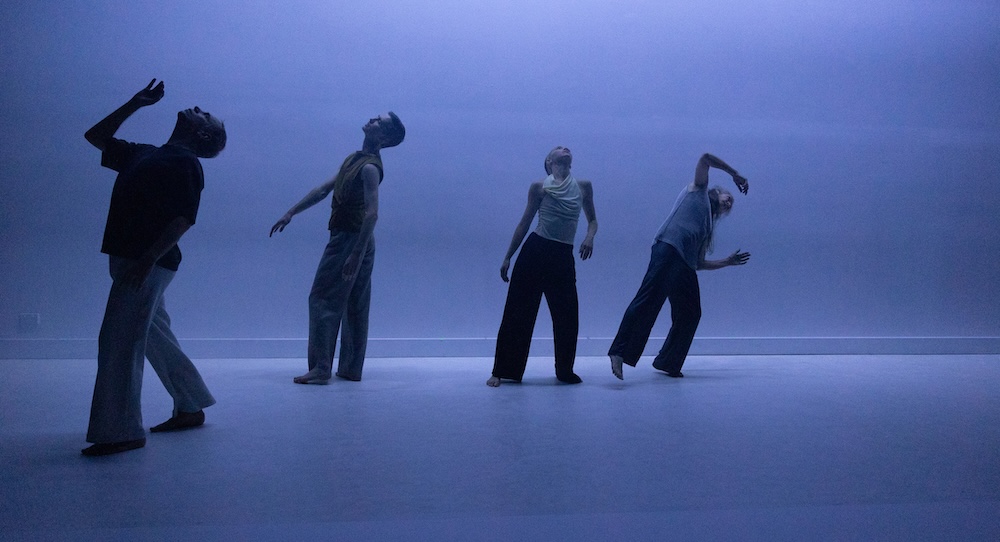
Bringing together four choreographers from different generations and distinct movement lineages, MSTM, presented by Campbelltown Arts Centre this past November, is a rare collaboration built on trust, deep listening, and an openness to transformation. In this conversation, Martin del Amo, Sue Healey, Tra Mi Dinh and Mitchell Christie reflect on the playful and rigorous process behind the work – from building a shared movement language without erasing individuality, to rethinking proximity, authorship and the act of watching.
MSTM brings together four distinct choreographic lineages. When you began this process, how did you approach establishing a shared space without collapsing your individual movement vocabularies into one?
Tra Mi Dinh
“We began with a lot of sharing – of past works, current interests… leading each other through structures/improvisations/experiences that we each find intriguing. This allowed us to create a solid foundation of shared practice that was deeply personal, inviting the four of us to deepen and expand our practices and approaches into new ones.”

Sue Healey
“It always felt like each of us had a distinct place within this work. The process was pure joy, play was always present, and nothing ever felt difficult or forced. Yes, we were four different choreographers, but we shared many influences (which we kept uncovering), and that created a deep sense of understanding.”
Mitchell Christie
“We had the time and space to share without compromise, developing a pretty immediate mutual trust between the four of us. Although this was a ‘new’ quartet, we entered this project as two pairs with existing collaborative practices and experiences in which we could draw from. A more critical negotiation is required in the later stages of development to narrow down what makes it in the show. This was the hardest part for me. I think the strength of our collaborative choreographic practice is underpinned by the fact that we all are interested in each other’s lives, and not just in a dance context.”
Martin del Amo
“Especially early on, we spent a lot of time getting to know each other’s distinctive ways of moving. We’d try to copy one another – not to get it perfectly right, but to capture the feel of someone else’s movement personality. That act of ‘trying on’ what makes each of us move the way we do was incredibly useful. It helped us understand where we differ, where we unexpectedly overlap, and how we might be able to contrast or combine our vocabularies without blending them into one.”
Throughout MSTM, there are extended moments where dancers watch each other – sitting, leaning, attending. How did you think about the relationship between doing and observing?
Dinh
“During our first development, it quickly became obvious that observing, and being observed, was a big part of our dynamic. Part of how one may attempt to embody a task, or practice first, comes from watching it unfold, observing the interplay between body and mind. In our attempts to ‘understand’ each other, it became imperative that we begin by watching. In doing so, we also appreciate the beauty of watching the watcher – celebrating the captive attention that enlivens the space between the performer and the watcher. Playing in this charged field of perception and exchange led us to also think about what may be purposely concealed and revealed, and how the manipulation of such shifts may affect what is understood and carried forward.”
Healey
“At the heart of our project was the question of how we see each other and allow ourselves to be seen. We had an exercise which we did regularly throughout the process…Person A observes Person B dancing (for five minutes), Person A then responds with their own solo (for three minutes). Then Person A creates a new solo (for five minutes), being observed by Person B, who then responds (for three minutes).

This exercise is so radically simple – just dance for someone and then respond. But in this simplicity, there is a whole world of complex decision-making and memory. Every time we practiced this process, it profoundly illustrated how a movement language is shared, filtered through our own lens and then morphed into the next generation.”
Christie
“I think that observing is doing and doing is observing. In developing MSTM, we tested our capacity to move and observe simultaneously, creating endless scores of transmission loops. There is so much information held in our bodies, and between the four of us, it felt like there was an encyclopedia of movement. Observing became such a huge part of realising what MSTM could be, so much so that we consciously employed it as a major choreographic feature of the performance itself.”
del Amo
“MSTM is essentially an exploration of how we collaborate. Watching, observing and witnessing were integral parts of how we got to know each other in the studio, and how we found our footing as a quartet. Including that dynamic into the work seemed to make sense. It offered us another mode of coexisting on stage that didn’t rely on everyone ‘doing’ at the same level all the time.”
You span different generations and eras of Australian contemporary dance. How did that shape the studio environment?
Dinh
“It meant that the room was full of a rich palette of choreographic aesthetic and performative qualities. Our varied interests in dynamic variation and stage presence was so fun to explore. Being in the studio together has been such an impactful experience for me. I was so happy to be working everyday with these wonderful artists – it felt like an extended workshop wherein choreographic practice was enriched and deepened through constant questioning and celebration. There was a lot of laughter between the four of us, which is why there is a quiet sense of cheekiness that lives throughout the work.”
Healey
“Anything felt possible!”
Christie
“Although we have different levels (and years) of experience under our belts, the dynamic was very much democratic. Difference is good, necessary even, to work as a team and dig deep into creation. Everyone showed up every day with an energetic curiosity and a drive to keep up with and challenge each other creatively.”
del Amo
“Intergenerational collaborations are frequently framed through a mentorship lens. For this project, though, we were adamant from the outset that we would meet as equals, working together as four individuals, each with different skills, styles, and histories. This non-hierarchical space allowed us to exchange, transmit and share authorship freely.”
With regards to the audience, how did you think about proximity, distance, and the invitation to ‘be with’ rather than simply ‘observe’?
Dinh
“Because our process in the studio was so intrinsically linked to the act of watching, we were very conscious of how we might invite the audience to broaden their own approach to witnessing and experiencing, not only dance but also the process of transmission. This manifested as inviting audiences into a gallery where dance ‘on’ and ‘with’ film collide – multiple films projected onto areas that command you to lean forward and down, or gaze up above the heads of fellow audiences, or past bodies to see live performers dancing with projected films of each other. As an audience, there is agency to follow your eye/interest across the room, expanding the narrow corridor of ‘seating bank, air, stage’ into an active space of concurrent energetic exchange. Here, in close proximity to live and projected dance, audiences can experience a sense of intimacy to both the ‘art’ and the ‘artists’… observing our quartet as an ever-evolving process of negotiation as we navigate choreographic tasks that heighten awareness by demanding presence.”
Healey
“I think this is a really important question for choreographers – especially in the socially disembodied age we’re living in. Finding ways to connect is vital, and challenging the norms of theatre-going has become critical. One of the unexpected benefits of being an independent artist (who often can’t afford to work in mainstream venues), is the freedom to question the traditional audience–performer relationship and to move beyond the frame of conventional theatre architecture. As a quartet, one of the first things we discussed was how to rattle the usual way of seeing dance – how we enter a space, how we shape the act of looking, and how audiences might experience proximity and attention differently. Large companies rarely get to do this because they’re tied to traditional theatre formats, but we can. My work in film has also fed this enquiry. When you’re working with a camera and editing, you’re constantly thinking about perspective, scale, and focus. Those tools have expanded my sense of what’s possible, revealing new ways of engaging an audience and reimagining the act of seeing.”
Christie
“With deep care, we wanted to reconstruct the typical audience-performer relationship by inviting you into (and through) the dance. The audience enters the performance space with us, an attempt to demystify the unknown of ‘backstage’ or ‘behind the scenes’. I think that this redirection does something sensational to the audience members’ bodies, too – they get to experience the curtains opening from onstage, revealing the seating bank from the performer’s perspective and traversing the dance floor to be seated. To then turn around and see the stage that they just walked across. It is part of the choreography. We really wanted to level with the audience and prime them to think about being observed whilst observing us.”
del Amo
“Unlike many other dance projects, MSTM didn’t begin with a clearly defined conceptual frame or theme. The work really grew out of the act of collaborating; the discoveries we made together and how we distilled them choreographically. Inviting the audience to enter from backstage felt like a way of bringing them into that ethos. Even before settling into their seats, they encounter us in a shared space and arrive within the world we’ve been building together.”
Was there anything that felt particularly vulnerable to share or negotiate – movement habits, authorship, aesthetic preferences?
Dinh
“Rather than vulnerable, I felt liberated – it was really interesting for our preferences to intersect, echo, or even oppose. This was mostly shared through doing – outlining our desires would pop up in situ and we’d follow the garden path of ideas as a way to understand what drives one another’s creative decision-making. Through shared critical interest or a voice of conviction and clarity, we found a way of working that was intuitive rather than systematic.”
Healey
“The fact that I’m in my 60s, more than twice the age of both Tra Mi and Mitch, was a considerable challenge for me personally. But the process was made so much easier by the deep respect within the group, and also by Anthea [Doropoulos] and her team at Campbelltown Arts Centre.
You can’t predict the outcome of a project like this. Would I make it through the physical demands of the process and the performance season? Would I have something relevant to offer? So yes, I was definitely vulnerable. But dance as an artform is not for the faint-hearted, and dancers are inherently courageous. I was prepared to meet the challenge. And it worked. I had an amazing time with these artists.”
Christie
“I think that collaboration, improvisation and performance always require a level of vulnerability in order to be meaningful.”
del Amo
“I try to think of vulnerability – when acknowledged – as a source of strength, and I’m often drawn to performing from that position. Still, the vulnerability that comes with performing alongside younger dancers is very particular. I definitely had moments of concern about discrepancies in fitness and skill levels, which was confronting at first. But the trust and mutual respect we built as a group kept those concerns at bay, allowing them to fade into the background fairly quickly.”

Has this collaboration shifted your own individual practice? If so, how?
Dinh
“It has shown me that collaboration is a very, very special way to spend time. Engaging in the playful, sacred, serious act of art making is a privilege, and to do it with artists who are so in love with dance is a true joy.”
Healey
“Collaboration has always been central to my work – in fact the cornerstone of everything I do – I was a founding member of Danceworks, in the 1980s in Melbourne, whose ethos was inherently collaborative, in ways that have never been duplicated by a company in Australia – But this took it to another level! I am extremely grateful to have experienced this project at this time in my career. To put it bluntly, given the current state of choreographic opportunity, it was a miracle that it happened.”
Christie
“Collaboration is the engine for everything that I make, even solo work. It’s not always easy, but MSTM felt easy. I’m really proud of the work, and it’s not lost on me how lucky I am to have made it with such iconic Australian artists. It’s been an incredibly reassuring experience.”
del Amo
“It’s probably too early for me to grasp the full impact MSTM will have on my practice. But returning to the studio solo last week, it genuinely felt as though Sue, Tra Mi and Mitch were still in the room with me. I’m still feeding off the ease with which we collaborated and the joy of sharing the stage. The experience is lingering and, I think, has the potential to reshape how I work on my own. How exactly it will manifest, I’m not sure yet, but I’m excited to find out.”
By Linda Badger of Dance Informa.
Share this: