
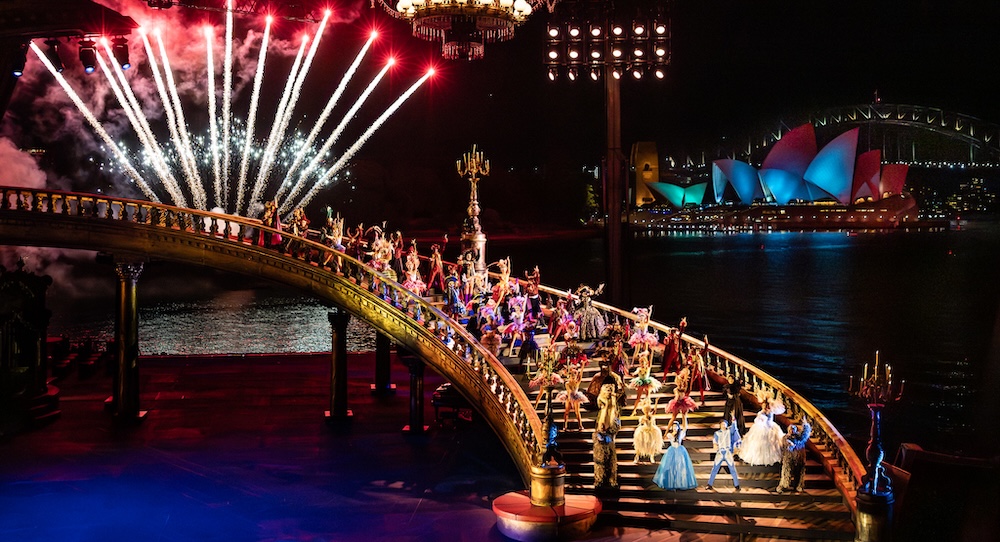
Sydney Harbour, Sydney.
27 March 2026.
On Friday, 27 March 2026, Handa Opera on Sydney Harbour unveiled a spectacular staging of The Phantom of the Opera, marking a milestone season within Opera Australia’s 70th anniversary, alongside the global 40th anniversary of Andrew Lloyd Webber’s iconic musical. Since its West End debut, the production had captivated more than 160 million people across 58 territories, 205 cities, and 21 languages – an extraordinary cultural legacy that continued to draw audiences worldwide. Even a crisp, drizzly opening night did little to diminish the atmosphere; black-tie elegance, masked glamour, and a luminous red carpet set the tone for an evening of theatrical splendour.
Originally based on The Phantom of the Opera by Gaston Leroux, the narrative drew deeply from Victorian Gothic traditions. Set within the opulence and shadowy depths of the Palais Garnier in 1880s Paris, the story wove romance with psychological tension – haunted spaces, obsessive love, and the tragic figure of Erik, the Phantom. The musical adaptation preserved this brooding atmosphere, subverting the notion of a conventional love story with a darker, more complex emotional undercurrent.
At the heart of the production was the enigmatic Phantom, portrayed with intensity by Jake Lyle, opposite Amy Manford as Christine Daaé. Their dynamic was charged with both vulnerability and power, capturing the tension between control and surrender. Christine’s relationship with Raoul, played by Jarrod Draper, provided a counterpoint of sincerity and grounded love, deepening the emotional stakes.
Few settings in the world rivalled the visual grandeur of this production. With the Sydney Opera House and Sydney Harbour Bridge forming the backdrop at sunset, the open-air theatre at Mrs Macquarie’s Point became an intrinsic part of the staging itself. The sets and costumes, designed by Gabriela Tylesova, were nothing short of spectacular, captivating the audience at every moment of the story.
The production opened with the iconic auction scene, where Raoul revisited the ghosts of his past. As the chandelier rose and the narrative slipped into memory, the stage transformed into the bustling world of the Paris Opera. The ensemble moved across the demanding raked stage with assured precision – on pointe, in heels, and through choreography seamlessly attuned to the production – revealing both strong characterisation and refined technical control.
In the subterranean labyrinth beneath the opera house, the number “The Phantom of the Opera” unfolded between the Phantom and Christine, showcasing Andrew Lloyd Webber’s unmistakable score. Their vocal command was undeniable, building with intensity to a powerful and impeccable crescendo by Manford as the scene glided across the lake, a lone boat drifting through shadow and light. One moment stood out, as Manford angled herself into the wind, allowing it to sweep through her flowing white gown and create a striking, almost ethereal visual, while she soared effortlessly through her powerful, resonant notes. Whether artistically directed or instinctive, it was moments of embodiment like this that truly elevated the show.
“The Music of the Night” followed with a haunting allure, the Phantom drawing Christine deeper into his world; the moment was both mesmerising and unsettling. As she fell into a trance-like state and later awakened, her curiosity heightened, pulling her further into his grasp.
Beneath the stage, the orchestra enveloped the open-air setting, its richness amplifying the spectacle as the harbour shimmered around the stage lights. The strength of the operatic and choreographic performances drove the narrative forward with clarity and emotional depth.
Act I built to a state of controlled chaos as the Phantom exerted his grip on the opera house, culminating in the dramatic chandelier crash – a moment executed with electrifying precision.
Act II shifted tone with the opulent “Masquerade” sequence, where Tylesova’s costumes took centre stage – intricate silhouettes, rich textures, and bold colour palettes creating a visual feast. The sweeping raked stage, grand staircase, and lake-and-boat configuration became integral to the storytelling, allowing the narrative to unfold across multiple dimensions. The cast moved seamlessly through the space utilising height, width, and depth with assured control – entering and exiting with fluidity that enhanced both tension and spectacle. Transitions were effortless, underscored by pyrotechnics that heightened the sense of scale and theatrical immersion.
As the narrative darkened, Christine became the focal point of a calculated plan to draw out the Phantom. Her visit to her father’s grave was particularly poignant, marking a turning point in her internal struggle.
The final confrontation was both intimate and explosive. When Christine removed the Phantom’s mask, the production leaned fully into its psychological core – revealing not just physical disfigurement, but emotional devastation. As the resolution unfolded, underscored by the Phantom’s isolation, it lingered long after the final note, leaving only the mask as a haunting symbol of his existence.
In contrast to the momentum of Act I, Act II felt slower, and it was disappointing to see the audience noticeably reduced. The storyline – focused on choosing love over fear and threaded with themes of manipulation and control – was unsettling and failed to resonate. Yet, within the context of the narrative, the period setting, and the overarching plot, it retained considerable theatrical merit. The dramatic stakes and character arcs remained compelling, even if the pacing could not match the electrifying energy of the first act.
Under the direction of Simon Phillips, the production achieved an extraordinary balance between spectacle and storytelling. The scale was immense, yet the emotional beats remained deeply human. Signature moments – the mirror, the descent to the lair, the chandelier – were reimagined with innovation and grandeur, elevated by the unique demands of an over-water stage.
The score remained one of musical theatre’s most enduring, from the soaring romance of “All I Ask of You” to the grandeur of “Masquerade” and the unmistakable power of the title theme. Against the shimmering backdrop of Sydney Harbour, it felt newly alive.
Details
Dates: 27 March – 3 May 2026
Venue: Fleet Steps, Mrs Macquarie’s Point, Sydney
Running Time: Approximately 2 hours 40 minutes (including interval)
Recommended Age: 10+ (contains loud noises, simulated gunshots, themes of violence, pyrotechnics, and depictions of hanging)
By Renata Ogayar of Dance Informa.
Share this: