
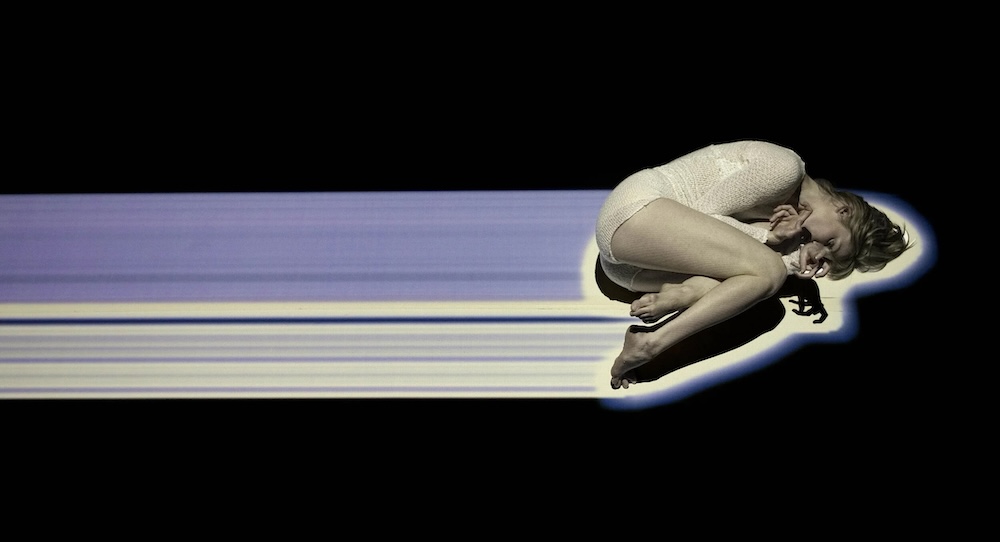
She says: “So many of my choices have been informed by the show, having embodied it for such a long time. But also, it’s so rare that you do a show that you get to see as well.”
He says: “Its influence on me was, like, what I could imagine being possible…and I actually ended up making works that were directly influenced by it. You know, using precision mapping and stuff like that.”
The work that Sara Black and Antony Hamilton are referencing is one of Australia’s most storied. First performed in 2006, Glow not only broke ground by partnering technology with dance but went on to become this country’s most toured contemporary dance show.

Now, two decades and several tech marvels further on, Glow returns to the Melbourne stage as part of the city’s winter arts festival, RISING. That it will be danced again by one of the original cast, and staged by its parent company, Chunky Move, is a symmetry worthy of the choreographic eye.
For Black (who won the Helpmann for her work in Glow), the return is not merely a curio or poignant talk point, but a rare perspective. This is the work that established her, launching a career that included roles with The Australian Ballet, Dancenorth and Lucy Geurin Inc, as well as two subsequent Green Room nominations.
“There’s definitely a lot to process,” she admits, “and a lot of honesty for myself, too, especially being 20 years older. I was 21 when we started it, and it was the start of my career, the beginning of everything. But we also toured it for seven years, so it lives deep within me.”
Back then, Black was one of seven women to dance Gideon Obarzanek’s now legendary solo creation. Recently, revisiting old videos, she has reconnected with much of the detail. Acknowledging her fellow performers, she quips, “I thank all those who have danced this, and for all the bits that I’ve pinched off them.”
More seriously, she adds, “I’ve had the opportunity to learn from them and take things on. Normally, we never get that. We’re always hearing the choreographer; so to get the chance to watch is rare.”
For current Chunky Move AD, Antony Hamilton, the restaging of Glow is a similarly full-circle experience. As he explains, “My relationship to the work is very much as a past audience member, where the work had this amazing influence, not just on me but on contemporary dance in Australia.”
Indeed, he likes to use the word “aspirational” to capture the impact it had. In 2006, it looked like the future.
Today, it is a legacy piece. Moreover, the motion tracking technology used by Obarzanek in works like Glow and 2008’s Mortal Engine was a blip. As Hamilton observes, it got “parked pretty quickly.” Thus, the old tech on display in 2026 will be new (novel) to many in this winter’s audience.

However, amidst talk of revivals and evolving technologies, there is a deeper, less linear current. Memory, tradition, etcetera. In an ephemeral artform like dance, we navigate these things differently.
“It’s not often contemporary dance works get revived,” Hamilton notes. “We live in a culture now that’s very ‘that’s past and we’re moving onto the next thing.’ We’re not really looking back, and there’s this perpetual cycle of new things every time. We’re in this interesting position now where we need to start asking ourselves which bits of history we need to start looking back on and reflecting on.”
Meanwhile, Black’s memory is intimate. Physical. On returning to the choreography she first danced in a younger body, she reveals, “Sometimes, when I stop thinking and let go, it just happens. But then I look back and go, ‘Ah no, I just skipped a whole section.’ So you definitely have to re-analyse and check things; but there’s a lot in the memory. More in the body than the brain.”
As one who now choreographs and teaches, she is also relishing the opportunity of sharing the RISING festival run with two new recruits, Chunky Move company dancer Melissa Pham and Sydney based indie artist Layla Meadows. “Teaching it to new dancers and seeing what they’ll bring to it — you know, their knowledge, their history, and how that again will influence me — will be an experiment.”
From Hamilton’s perspective, as the current incumbent at the company Gideon Obarzanek started, the task of bringing Glow back to the stage requires careful handling. “At this point, my relationship is somewhat at a distance, and just, like, gently coordinating it,” he outlines.
That Obarzanek is currently one the principals at the RISING organisation is also part of the equation. As Hamilton describes it, “We absolutely came to him with this. I wouldn’t say as a gesture of acknowledgement but, to some degree, I did want to make that gesture because of the legacy he has with this company. There is such a thing as tradition and, yeah, what do you do with it?”
The remaining elephant is something the work held at its creative core back in 2006. Twenty years on, technology, it seems, is on the brink of yet another step change. Apocalypse? Utopia? The jury, for now, is still out on AI. However, should we manage not to kill ourselves or terminally fracture all social bonds with our latest tech-toy, we may see a revival in the primacy and power of live performance.

Hamilton has a history of pondering technology and futurist possibilities. He is quick to chime in. “One thing I think about a lot with AI is that we’ve suddenly moved into this world where seeing is not believing anymore. [Then] I look at that and think, ‘Ah, fantastic, because now you actually have to be in a real environment to have evidence that something happened.’ That gives live performance a really beautiful, elevated position once again. Like, you have to be there or you won’t be able to trust the reality.”
From her perspective as both performer and parent, Black is likewise both cautious and upbeat about AI. Thinking about Glow in 2026, she concludes, “People have reached out who have studied it at school but haven’t been able to see it. Now they get to watch it in real life, in a room, with a live body on stage, and not just watching it on a screen.”
Here perhaps, the true legacy of Gideon Obarzanek’s form shifting masterpiece. Not a cyborg future, nor a few old videos for young dancers to pick over, but a living, moving moment. Ephemeral. Human. Real.
For more information, visit chunkymove.com/works/glow.
By Paul Ransom of Dance Informa.
Share this: