
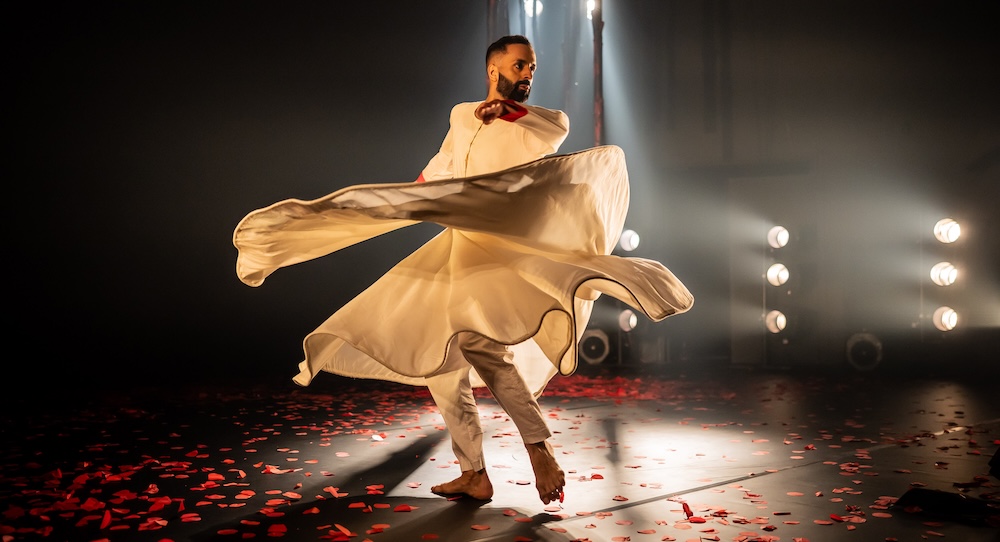
Playhouse Theatre, Sydney Opera House.
28 January 2026.
Birdsong is fleeting – like dance, it exists only in the moment, vanishing as soon as it is sung. Songs of the Bulbul, performed by Aakash Odedra at the Sydney Opera House, embraces the ephemerality with devasting beauty. Drawing from Persian and Sufi mythology, the work offers a deeply internal, spiritually charged meditation on captivity, sacrifice, and ultimate release.
The stage opens in near darkness, candles lining the left side while Odedra is alone, centre stage. From the outset, the atmosphere feels ceremonial, almost devotional. Odedra wears a white costume with a long, whirling-dervish-like skirt, marked by a single red stripe running down the back. The costume evokes both purity and sacrifice – an image that subtly foreshadows the blood and devotion central to the bulbul myth. There is no head covering, and in his final bows, Odedra gestures in quiet reverence, suggesting a spiritual lineage that extends beyond performance into prayer.
This is a 60-minute solo, yet at no point does the work feel sparse. Odedra commands the space with extraordinary focus, holding the audience in rapt attention. His performance is intensely internal – less about outward display and more about embodiment. While elements of contemporary dance appear, the movement language is firmly rooted in Kathak, particularly in the astonishing control and stamina of his spinning. His turns are not simply virtuosic; they feel meditative, as though each rotation is a prayer etched into the air.
Songs of the Bulbul unfolds through what is described as the four stages of the bird’s refinement – a process of increasing restriction imposed upon the bulbul in captivity. Before the dance begins, a voiceover recounts the legend, including the harrowing moment when the bird’s eyes are removed so it may sing more beautifully. The audience audibly gasps at this description, and the tension lingers: how will this brutality be translated into movement?
Suspended wooden sticks hang on the right side of the stage, evoking both a cage and the threat of violence. At one time, they strike the floor. When the moment of blindness arrives, Odedra does not literalise it. Instead, he releases a raw, guttural scream – an unforgettable sound that seems to tear through the theatre. The restraint leading up to this moment makes it all the more powerful. It is not spectacle, but rapture. The anguish at the loss is palpable.
The music – sung in an Indian language – guides the emotional architecture of the work. Though its literal meaning may be inaccessible to some audience members, its impact is unmistakable. Orchestral, mournful, and soaring, the score carries the bulbul’s journey through despair, devotion, ecstasy, and surrender. Joy and grief coexist, mirroring the Sufi belief that suffering can be a path to divine love.
Visually, the work is stunning, with lighting functioning as an active partner rather than a backdrop. Odedra manipulates light with remarkable precision, at one point quite literally conducting the candles on and off as though he were an orchestra conductor. Their flickering intensifies in a measured crescendo, rising and falling in exact communion with the music and movement, and building towards the works final moments with exquisite control. Earlier, he holds a single light, passing it between his hands as if cradling life itself. He dances around it before releasing it upward, where it ascends and disappears – a quiet, devastating metaphor for transcendence and loss. Throughout, the lighting never overwhelms the space, instead carving intimacy through shadow, side light, and overhead beams.
Perhaps the most striking image arrives at the very end. As the bulbul is finally released through death, Odedra arches backward, his body suspended in a vulnerable, inverted curve. Smoke pours from his mouth, as though the soul itself is leaving the body. The image is haunting and tender – a visual exhale after an hour of restraint. The audience respond with a spontaneous standing ovation.
Throughout the work, red petal-like fragments swirl across the stage, animated by fans positioned at either side. Sometimes, they drift gently; at others, they whip into a storm, responding to shifts in music and movement. These petals – suggestive of roses, blood, devotion – dance alongside Odedra, becoming silent partners in the storytelling. A gossamer piece of fabric briefly enters the choreography, floating and shimmering as if alive, echoing the fragility and impermanence of breadth and song.
Odedra’s physicality is remarkable not only for its precision but its lightness. At times, he appears to skim the floor, rising onto the very tips of his toes, giving the illusion of flight. There are fleeting hints of ballet in his elevation and line, though these read less as stylistic borrowing and more as an instinctive embodiment of wings. Beginning low to the ground, with movement that evokes hatching and emergence, and later returns to this imagery in a second, more spiritual rebirth.
From Persia to the Indian subcontinent, from freedom to captivity, Songs of the Bulbul traces the soul’s longing for union with the divine. Odedra poses a quiet but profound question: will we remain caged by the material world, or will we surrender – like the bulbul – and sing ourselves into liberation?
This is not just a dance performance; it is an offering. Fleeting, exquisite, and unforgettable.
Songs of the Bulbul will be presented at Playhouse, Arts Centre Melbourne from 3 – 7 February. Following the Melbourne season, Songs of the Bulbul will be performed at Perth Festival from 13 – 15 February.
By Linda Badger of Dance Informa.
Share this: