
Carriageworks, Sydney.
29 November 2025.
Sydney Dance Company’s Pre-Professional Year program has long been recognised for shaping young dancers into adaptable, intelligent artists, ready to enter the contemporary dance sector. PPY25 Revealed, presented over the weekend at Carriageworks, offered a glimpse into the 2025 cohort’s breadth, curiosity, ad developing identities as performers. Under the guidance of Head of Training Linda Gamblin, with lighting by Karen Norris and costumes by Harriet Ayres, the evening showcased five works ranging from professional repertoire to brand-new commissions – an ambitious spread that tested the dancers in multiple directions.
Zee Zunnur’s The Other Angels (composed by Peter McAvan) opened the night with a vivid, textural world drawn from her Morphology movement practice, inspired by shape-shifting invertebrates and the ruptures ad vibrations of their imagined ecosystems. Ayres’ striking white costumes – with opaque panels, tracing lines, and charcoal chiffon that shifted between anchored and floating – created an immediate visual tenison. Zunnur’s choreography felt tribal and instinctual without leaning on any specific cultural source, instead building its own raw physical language. The dancers roamed the space as if encountering foreign terrain, their bodies morphing through linear groupings, canons, and burst of collective force. As an opener, it was commanding, eccentric, and memorable.
Richard Cilli’s Throng (Sidewalk Dances) (Fourteen Moondog Pieces composed by Joanna MacGregor) provided a tonal shift: playful, rhythmically buoyant, and refreshingly simple in its costuming. The business-style shirts worn by the cast created a satisfying kinetic texture. This was the sole work featuring the Year 1 students, and they rose to the occasion with spirit and cohesion. Cilli’s structure gave them room to enjoy the dance – to lean into unison, interruptions, and musical responsiveness – without overreaching.
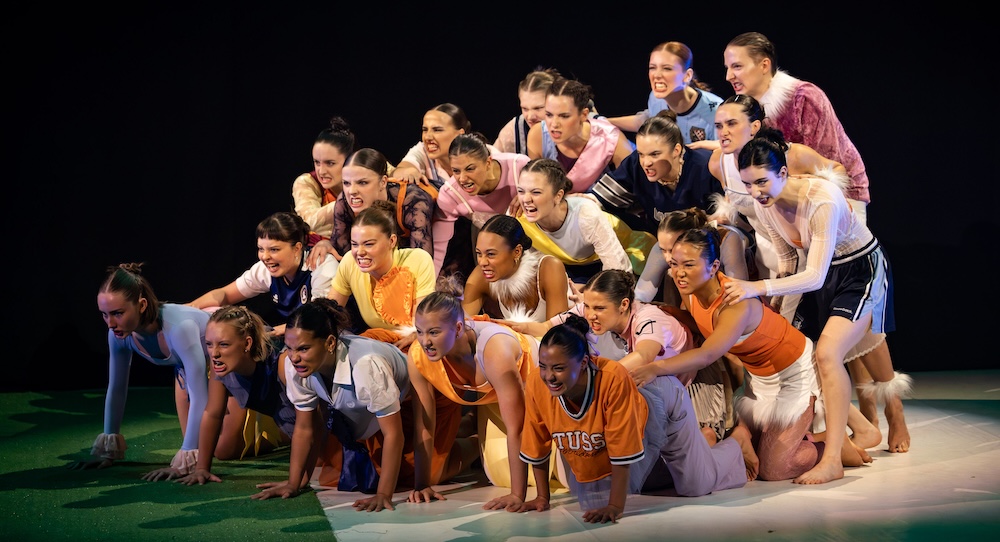
Emma Harrison’s Top Dog (composed by Amy Flannery) plunged gleefully into satire, using the world of pageants and competitive dog shows to explore tall poppy syndrome, ambition, and the politics of visibility. In typical Harrison fashion, the work blended humour, grit, and theatricality, inviting the dancers into a task-based process that foregrounded character and play. The cast embraced the vocalisation, odd sounds, and performative exaggeration with admirable bravery, Ayres’ costumes – a wild mix of ’80s glamour, sportswear, oversized bows and prize tags – heightened the absurdity. The work offered the students a vital chance to engage with the comedic and theatrical side of contemporary practice, ad to discover that choreography can provoke, poke, and critique just as effectively as it can move.
Thomas E.S. Kelly’s Gibuum (also composed by Kelly) brought a deep shift in tone, anchored by First Nations storytelling and the cosmological journey of sky being traveling to deliver new songs and dances. Kelly’s work is always rooted in ancestral knowledge and Gibuum asked the dancers to tap into a more internal, grounded mode of performance. The result was atmospheric and thoughtful, stretching the dancers’ vocabulary while immersing them in narrative-driven contemporary dance. It was another reminder of the program’s emphasis on exposing emerging artists to varied methodologies and cultural perspectives.
The evening concluded with an excerpt from Rafael Bonachela’s Lux Tenebris (composed by Nick Wales), restaged by Juliette Barton and Madeline Harms with sensitivity to the students’ developing strengths. It gave the cohort the valuable experience of embodying Sydney Dance Company repertoire – demanding, fast, and intricately musical. Although adapted for the group, the essence of Bonachela’s style remained intact, no mean feat for student dancers, they attacked it with commitment, clarity, and impressive stamina.
PPY25 Revealed highlighted a group of dancers who are energetic, hardworking, and eager to take artistic risks, while they are still early in their technical and performative development – something evident in moments of youthfulness or unevenness across the cohort – they also show real potential. Several dancers stood out as particularly strong, and all demonstrated a willingness to dive fully into each choreographer’s world.
The diversity of the program was one of its strengths: five contrasting works, five distinct creative processes, and five opportunities for the dancers to stretch into the different corners of contemporary practice. As a graduation showcase, it illustrated exactly what the PPY program is known for – breadth, curiosity, resilience and the first steps toward grounded professional artistry.
PPY25 Revealed was not just a celebration of a cohort; it was a reminder of how training spaces like this shape the future fabric of the sector.
By Linda Badger of Dance Informa.
Share this: